
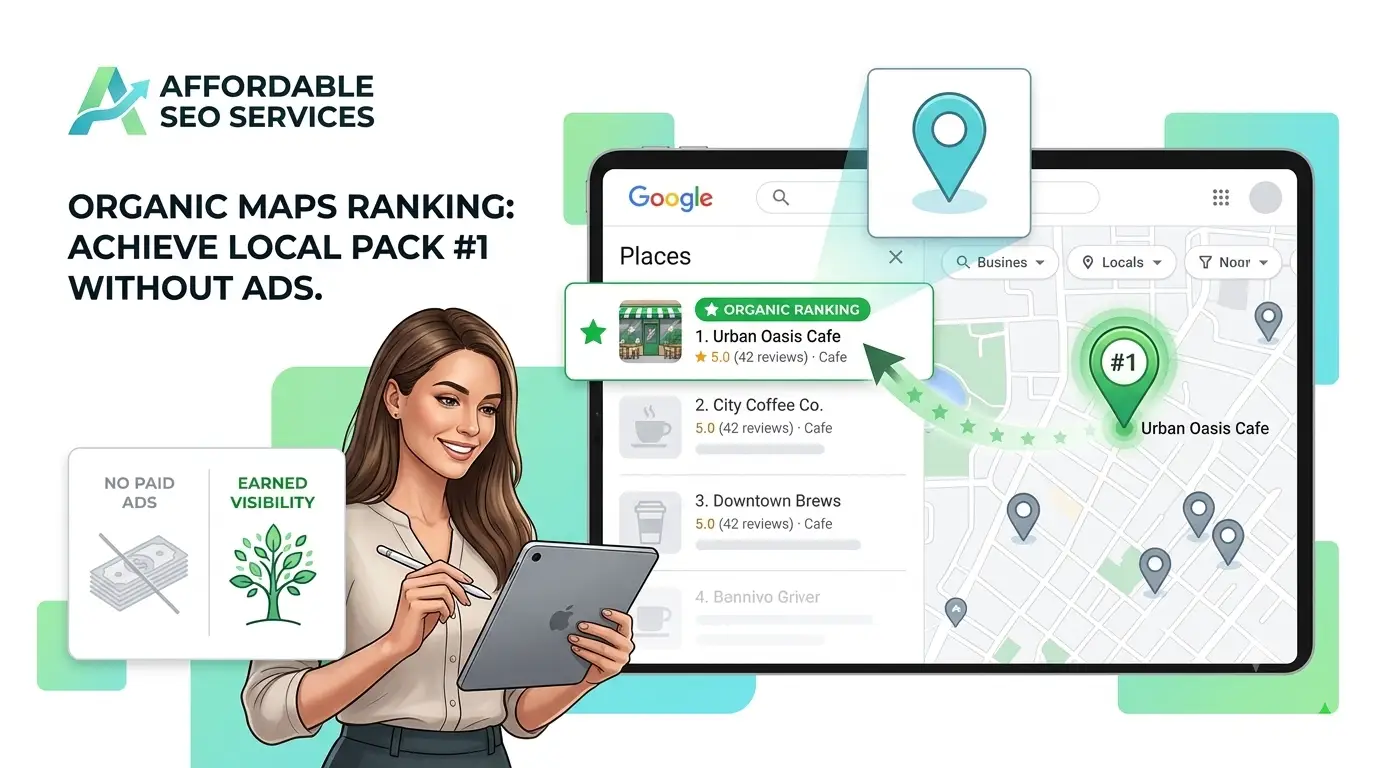
How to Rank in Google Maps Without Spending on Ads comes down to three things Google measures, which are how relevant your profile is to the search, how close you are to the searcher, and how prominent your business looks across the web. Your organic Google Maps ranking is the sum of those three. Get your Business Profile, reviews, citations, and website pulling in the same direction, and you climb the map for free.
Most small business owners assume the top three spots on the map are bought. They are not. You can rank in Google Maps without spending on ads, and the businesses sitting in the Local Pack in your town earned those spots with organic signals you can build yourself. This guide shows you how to improve Google Maps listing performance with every signal that actually moves a listing up, from your Google Business Profile to the AI-driven local search features that arrived in 2026, and most of your competitors are still ignoring half of them.
A spot in the Local Pack is worth fighting for. A SOCi study found that businesses appearing in the top three map results receive 126 percent more traffic and 93 percent more customer actions, things like calls, direction requests, and website clicks, than businesses ranking just below them. Those map pack clicks go to the top three, not to the listings below. Strong Google Maps SEO for small business owners is the highest return marketing work available, and everything in this guide is built to increase Google Maps visibility organically, with no media budget.
This guide reflects how we approach local search at Affordable SEO Services, where we help small businesses climb the map without paying for ads. Whether you follow these steps yourself or hand them off, the playbook is the same.
How Does Google Maps Ranking Work
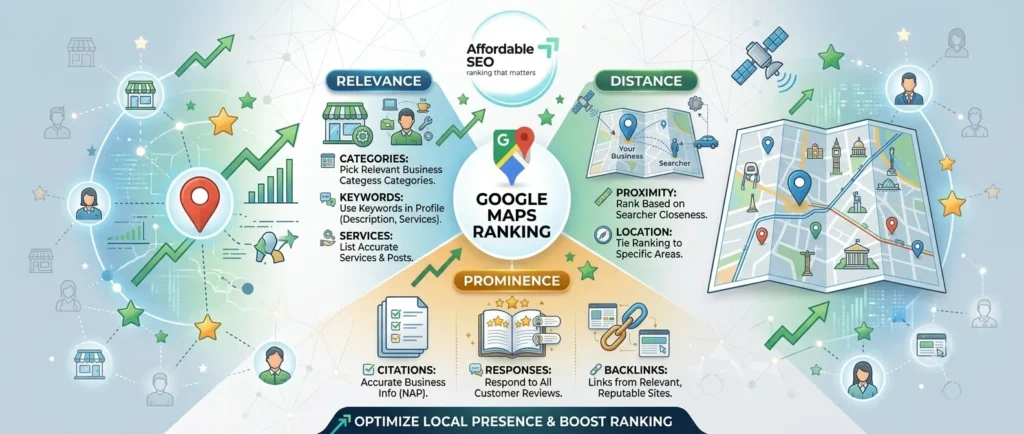
What determines your Google Maps position comes down to three core factors Google states publicly in its own support documentation, namely relevance, distance, and prominence. Local SEOs often shorten this to the relevance distance prominence model. Everything else you read about local SEO is a tactic that strengthens one of these three pillars.
Relevance is how closely your Business Profile matches what someone typed. A plumber who lists water heater repair, drain cleaning, and sewer line service is more relevant to those searches than one who only writes “plumbing.” Your category, services, and description tell Google what you do and how well you match local search intent.
Distance is how far your business is from the searcher or the place named in the query. You cannot move your pin, and that is fine. Strong relevance and prominence let you outrank closer competitors who have weaker profiles, which is exactly how a business two miles away beats the shop next door despite weaker proximity signals.
Prominence is how well-known and trusted your business looks online. Reviews, citations, backlinks, and behavioral signals such as click-to-call and direction requests all feed it.
Taken together, these are how Google gauges a local business’s E-E-A-T, its experience, expertise, authoritativeness, and trustworthiness. Local prominence grows with every review, citation, and link you earn, which makes this the one pillar you can build indefinitely, and it is where most of your organic effort pays off.
If you have been searching for how to rank higher on Google Maps, the honest answer is that every tactic that works ladders up to one of these three pillars. There is no separate shortcut hiding behind them.
The relative weight of these organic ranking factors keeps shifting. Whitespark’s Local Search Ranking Factors survey, which has polled local SEO experts annually since David Mihm started it in 2008, released its latest edition in November 2025 with 47 experts scoring 187 possible factors. Their consistent finding is that your primary business category is the single strongest individual relevance signal, while reviews and links dominate prominence.
Why Google Maps Rankings Beat Ads in 2026
Paid local ads sit above the map, but searchers know the difference. You can rank in Google Local Pack without paid ads and earn more trust doing it, because a listing that earns its position carries credibility a “Sponsored” label cannot buy, and that trust converts into organic local traffic.
The bigger reason organic ranking matters now arrived in March 2026. Google launched Ask Maps, a Gemini-powered conversational feature that lets people ask full questions inside Google Maps, things like “which electrician near me handles panel upgrades tonight.” Ask Maps rolled out first in the United States and India on Android and iOS, and according to Google, it does not run ads inside the feature at launch. It builds its answers from organic signals, including complete Business Profiles, review quality, and what your website says about you.
A common misunderstanding is already spreading, so let me be precise. Ask Maps and the AI Overviews you see in Google Search are separate interfaces and are not wired together yet. What they share is the signal set that powers both. Agencies tracking the rollout, including ALM Corp, point out that complete profile data, strong reviews, and authoritative web citations improve your local business visibility in both places at once.
There is a second AI shift worth naming. BrightLocal’s 2026 Local Consumer Review Survey found that the share of consumers using tools like ChatGPT for local business recommendations jumped from 6 percent to 45 percent in a single year. ChatGPT pulls much of its local data from Bing, which is one reason syncing your information to Bing Places now matters more than it used to.
The businesses winning local search in 2026 are not the ones with the biggest ad budgets. They are the ones with the cleanest organic foundation, and you can rank on Google Maps for free by building it. This is local SEO without paid ads, and it works without paying Google a cent.
Step 1: Claim and Fully Optimize Your Google Business Profile
Your Google Business Profile, formerly Google My Business, is the most important ranking asset you control. Whitespark’s expert survey consistently ranks it as the most influential category in the entire local algorithm, which means an incomplete profile is the most common reason a business cannot rank in Google Maps without ads. The Google Business Profile optimization tips that follow show you how to optimize Google Business Profile fields one by one, and much of what people still call Google My Business optimization now lives inside this dashboard.
Business verification is the first gate. Unverified listings can show on the map, but Google deprioritizes them. Verification happens by postcard, phone, email, or video, depending on your business type.
Once verified, fill in every field. Business profile completeness is itself a ranking signal, so empty fields are missed opportunities.
- Business name. Use your real-world name exactly as it appears on your signage. Do not pack keywords into it. Google’s August 2025 spam update specifically targeted business name stuffing and has been suspending profiles that add city or service keywords to a name that does not match reality.
- Primary category. This is the most powerful relevance signal in your whole profile. Pick the most specific category that matches your core service. A kitchen remodeler should choose “Kitchen Remodeler,” not “General Contractor.”
- Secondary categories. Add as many relevant ones as apply, up to nine. A dental office might set “Dentist” as primary, then add “Cosmetic Dentist,” “Emergency Dental Service,” and “Teeth Whitening Service.” Each one makes you eligible for more searches.
- Business description. You have 750 characters. Describe what you do, who you serve, and what sets you apart, using the words your customers actually use. A natural keyword in business description text helps, but write it for a reader, not for a robot.
- Services and products. List every service with its own short description. Google matches this content to specific queries.
- Hours. Keep them accurate, holidays included. Wrong hours create bad behavioral signals when customers show up to a locked door.
- Q and A section. Seed it yourself. Post and answer the five to ten questions customers ask before they call.
- Google Posts. Google Posts weekly updates keep the profile active, so publish a short one most weeks. An actively managed profile sends freshness and user engagement signals.
Do Photos Actually Help You Rank in Google Maps
Yes. Google’s own data shows that profiles with photos earn 42 percent more direction requests and 35 percent more clicks through to their website than profiles without them.
Upload fresh images regularly rather than once and never again, since recency reads as an active business. Rename files descriptively before uploading, so denver-hvac-furnace-repair.jpg beats IMG_4021.jpg. Geotagged photos help further, since the location metadata reinforces where you operate. Cover the things searchers want to see, including your storefront, your team, your work, and the inside of your space.
Step 2: Choose the Right Business Categories
Business category selection deserves its own step because it is the single most important decision in your profile and the one businesses most often get wrong. Your primary category acts as a filter that decides which searches you are even eligible to appear in.
Audit your top three competitors before you settle on yours. If the businesses ranking above you all use a specific primary category, and you picked a broader one, switch to match. A personal injury firm listed simply as “Lawyer” is telling Google it is less relevant for “personal injury” searches than a firm listed as “Personal InjuryAttorney.”
Then add secondary categories that genuinely describe additional services, and prune anything that does not. Irrelevant categories dilute your relevance rather than expanding it. The goal is a profile Google can describe in one confident sentence.
Step 3: Build Reviews Systematically Without Buying or Begging
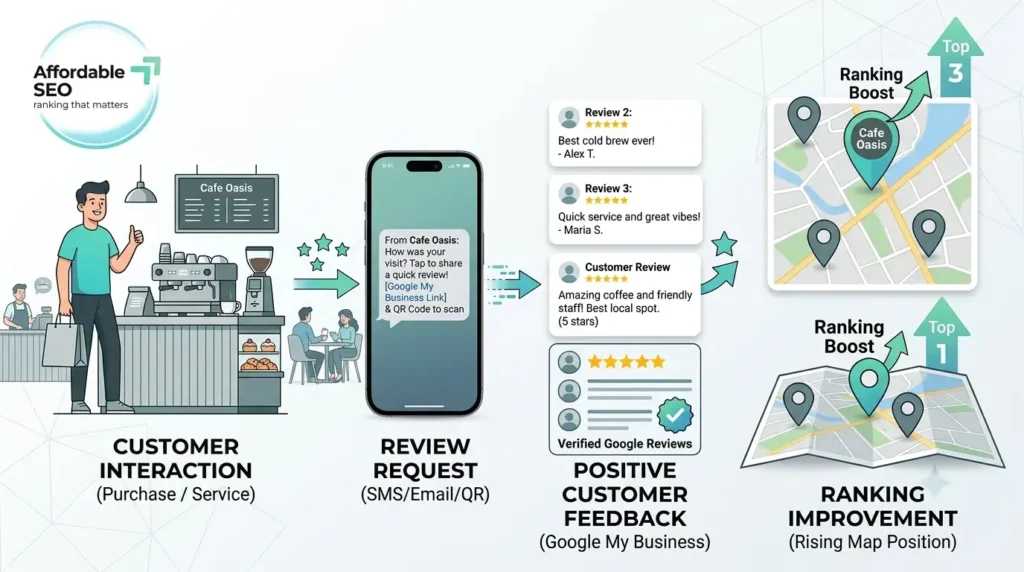
Reviews move your ranking in two ways. They are a direct prominence signal through their quantity, recency, and average rating, and the text inside them is indexed. When a customer writes “best HVAC repair in Denver,” that phrase becomes part of your profile’s content and strengthens your relevance for that search.
Reviews matter to humans even more than to the algorithm. BrightLocal’s 2025 survey found that only 4 percent of consumers never read business reviews, and its 2026 edition found that 68 percent of consumers will only use a business rated four stars or higher, up sharply from 55 percent a year earlier. A weak review profile loses customers before Google is even involved.
The failure is rarely that customers refuse. BrightLocal’s research has long shown that roughly three-quarters of people who are asked to leave a review go on to do it. The problem is that businesses do not ask.
Here is a simple review generation strategy that works.
- Ask every satisfied customer right after a positive moment. A request two hours after the job converts far better than one sent a week later.
- Send a direct link to your Google review form, not your profile homepage. Every extra tap loses people.
- Use the channel that fits. Retail can put a small QR code card at the counter. Service businesses can send a follow-up text with the link.
- Train everyone to ask. The owner asking converts the highest, but any consistent ask beats no ask.
Velocity beats bursts. Ten reviews arriving steadily over ten weeks carry more weight, and look far more natural to Google’s spam filters, than ten reviews landing in one afternoon. Buying reviews is the fastest way to get filtered or suspended, so do not do it.
One honest caveat on ratings. Research from Northwestern University’s Spiegel Research Center found that a rating in the 4.2 to 4.5 range often builds more trust and converts better than a flawless 5.0, which many shoppers read as too good to be true. A handful of mixed reviews you have answered well can actually help you.
How Should You Respond to Reviews
A steady Google reviews response habit matters as much as collecting the reviews themselves. Reply to every review, positive and negative, ideally within a couple of days. Your responses are indexed and add keyword-rich content to your profile.
A 2017 study by researchers Davide Proserpio and Georgios Zervas, published in Marketing Science, found that businesses that began responding to reviews saw their average
ratings rise over time, partly because engaged owners attract more measured feedback. For a negative review, keep it to one sentence acknowledging the experience and one offering to fix it offline. Skip the defensiveness.
Step 4: Fix Your NAP Consistency Across Every Directory
Your NAP (name, address, phone number) is the trio of details Google checks across the web. When your business shows as “Johnson Plumbing LLC” on your profile, “Johnson Plumbing” on Yelp, and “Johnson’s Plumbing” on Yellow Pages, Google’s systems register a mismatch and trust the citations less.
Moz’s State of Local SEO research repeatedly places citation consistency among the most influential local ranking factors. This is foundation work, not a finishing touch, and getting it wrong quietly caps how high you can rank.
The fix is methodical.
- Run a citation audit with a tool such as BrightLocal, Moz Local, or Semrush Local. Each one surfaces every place your business appears and flags inconsistencies.
- Correct the major data aggregators first, since Data Axle, Neustar, and Foursquare feed hundreds of downstream directories. Fix the source and the corrections cascade.
- Then clean up the high authority directories one by one, starting with Yelp, Apple Maps, Bing Places, Tripadvisor, Yellow Pages, Foursquare, Facebook, and the Better Business Bureau.
- Match your Business Profile exactly everywhere, down to the same abbreviations, punctuation, and suite format.
Step 5: Build Local Citations With Quality Over Quantity
A local citation is any online mention of your business’s NAP on an external site, whether a directory, a review platform, a local blog, an industry association, or a news outlet. Local citation building is the work of earning these mentions on the right sites. Citations feed prominence, so more consistent mentions on trusted sites mean stronger authority signals to Google.
Spread your effort across the sources that carry weight rather than chasing volume.
- Core directories for almost everyone. Yelp, Apple Maps, Bing Places, Tripadvisor, Yellow Pages, Foursquare, Facebook, Better Business Bureau, and your local Chamber of Commerce.
- Home services. HomeAdvisor, Angi, and Houzz.
- Healthcare. Healthgrades and Zocdoc.
- Legal. Avvo.
- Your niche. Whichever trade associations and regional directories your industry respects.
Fifty listings on authoritative, relevant directories will outperform 500 on low-traffic citation farms. Match your NAP to your profile exactly, and include your website wherever the directory allows it.
Step 6: Optimize Your Website for Local SEO Signals
Your profile does not stand alone. Local SEO Google Maps optimization also depends on your website, because Google cross-references it to confirm what your business is, and a thin or generic homepage undercuts even a strong profile.
Build a dedicated location page with your full NAP in text, an embedded Google map, your hours, and your service list. If you serve several towns, create genuinely distinct geo-targeted landing pages for each one with local proof, not a template with the city name swapped out. Cookie-cutter pages get treated as thin content and rarely earn rankings.
Speed and stability matter too. Run your pages through Google’s PageSpeed Insights and aim to pass Core Web Vitals. Core Web Vitals local SEO performance affects both rankings and conversions, because a slow mobile experience pushes away the exact near me searches most likely to call you. Make sure your phone number is tappable on mobile and your address links straight to directions.
Step 7: Add LocalBusiness Schema Markup
Local schema markup is structured code you add to your site that tells search engines explicitly what your business is, where it sits, and what it offers. This is the technical step almost none of the top-ranking articles cover in full, which makes it a genuine edge.
LocalBusiness schema is written in JSON-LD and placed in the code of your location pages. This local business structured data spells out your name, address, phone, hours, geographic coordinates, services, and review rating in a format Google reads with zero ambiguity. That clarity feeds the Local Pack, rich results, and the citations AI features pull when they build an answer about you.
To put it in place, generate your LocalBusiness JSON-LD with a free schema generator, paste it into the head of each location page, then confirm it with Google’s Rich Results Test before you move on. The validation step matters because a broken schema helps nothing.
Step 8: Earn Local Backlinks and Brand Mentions
Backlinks remain a prominent factor, and locally relevant ones carry the most weight for the map. A link from a low competition national blog does less for your local ranking than a link from a source rooted in your community.
Look close to home for these. Sponsor a local event or youth team and earn a link from their site. Join your Chamber of Commerce and relevant trade associations. Offer a quote to a local journalist or a guest piece to a regional blog. Each locally anchored link tells Google your business is a real, recognized part of its area, and in a tight market, that can be the difference between position four and position one.
Step 9 Optimize for Voice Search and Near Me Queries
Voice search local queries and near me searches reward content written the way people actually speak. Someone typing searches “dentist 80203,” but someone speaking asks, “Who is the best emergency dentist near me open right now?”
Answer those spoken questions directly somewhere you control. Seed your profile Q and A and your website FAQ with full conversational questions and plain, complete answers. Keep your hours and “open now” status accurate, because so many spoken local searches carry urgent, real-time intent. This plain-spoken content drives search intent matching, and it is exactly what Ask Maps and other AI answer layers extract when they decide which business to recommend.
Step 10: Show Up in AI Overviews and Ask Maps
AI Overview, local search, and the Ask Maps Gemini experience do not run on a separate, secret ranking system. They run on the same signals you have been building through the previous nine steps, which is the good news.
To appear when someone asks Ask Maps a conversational question, make sure your primary category is exact, your services are listed in plain language, your reviews are recent and specific, and your website explains your offerings clearly enough for a model to quote. Because ChatGPT leans on Bing data for local answers, claim and complete your Bing Places listing so AI tools that bypass Google still find you. Then test it yourself by asking Ask Maps a few questions a customer in your category would ask, and watch whether your business surfaces and whether what the AI says about you is accurate.
One more prominent note for the AI era. BrightLocal’s 2026 data showed Apple Maps usage nearly doubling year over year, from 14 percent to 27 percent, so a complete, consistent Apple Maps listing is no longer optional for reaching iPhone users and the assistants that draw on Apple’s data.
How Long Does It Take to Rank in Google Maps
If you are wondering how long it takes to rank on Google Maps, here is the honest range. For low to medium competition categories, expect noticeable movement in 30 to 90 days if you complete the foundational steps at once rather than spreading them over months. For high competition verticals such as law, dentistry, and lending in major metros, plan on 6 to 12 months of steady work.
The pattern that ranks fastest is doing everything at once early. Overhaul the profile, clean the citations, set up the review system, and add schema within the first 30 days, then keep the maintenance steady. Weekly posts, prompt review replies, monthly photos, and a couple of quality citations a week compound the way interest does. There is no overnight version of this, and anyone selling you one is selling risk.
That front-loaded month is where most owners run out of time. If you would rather not juggle it alone, this is the work we handle for clients at Affordable SEO Services, building the full foundation and maintaining it month to month at a price made for small businesses.
Special Tactics for Service Area Businesses
If you travel to customers rather than hosting them, plumbers, electricians, cleaners, and HVAC technicians, you are a service area business, and Google treats you a little differently. You can and generally should hide your street address and set a defined service area instead, which is the policy-compliant setup for businesses without a public storefront.
Hiding the address does not, by itself, lower your ranking, despite a persistent myth that it does. What helps you reach further is prominence and relevance, built from real local content, consistent citations, locally anchored links, and steady reviews from across the areas you serve. Service area settings tell Google where you work, but testing across the industry shows they do not expand your ranking on their own, so build genuine signals for each area you want to win.
Track Your Google Maps Rankings
Average position lies to you in local search, because where you rank changes block by block, depending on the searcher’s distance. A single “you rank fourth” number hides the fact that you might be first in one neighborhood and invisible in the next.
Use a map rank tracker instead. A geo-grid ranking tool, such as Local Falcon, GMB Crush, or Places Scout, checks your ranking across a grid of points around your location for the keywords you care about, so you can see exactly which neighborhoods you own and which you are losing. Then put your effort where you are close to breaking into the top three, since those are the fastest wins.
Google Maps Optimization Checklist for 2026
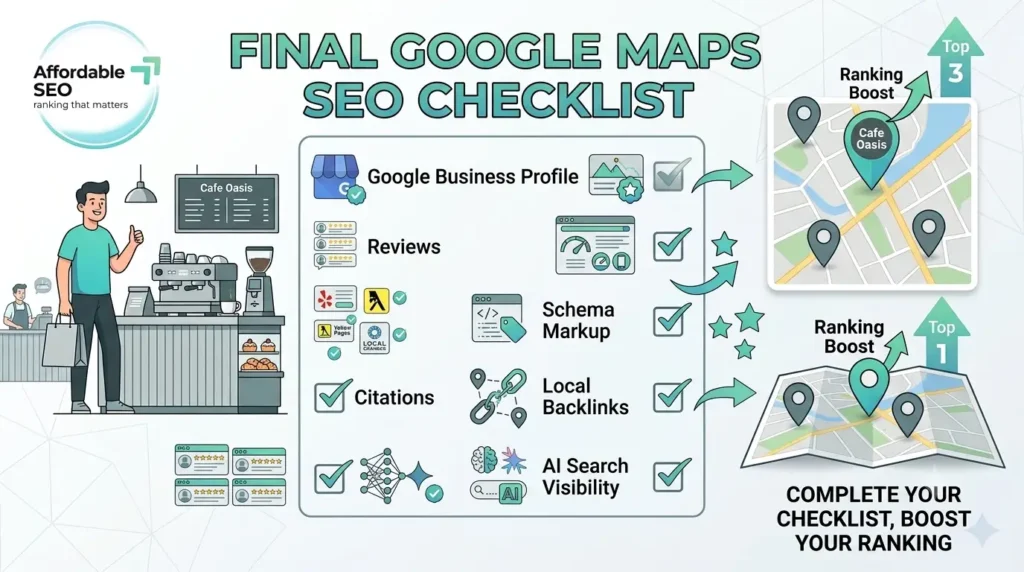
Use this Google Maps SEO checklist to audit where you stand today before you start fixing things. Work top to bottom, since the earlier items carry the most ranking weight.
Google Business Profile
- Profile claimed and verified
- Most specific primary category selected
- Relevant secondary categories added, up to nine
- Business description written in natural customer language, up to 750 characters.
- Every service is listed with its own description
- Hours accurate, holidays included
- Fresh photos were uploaded recently
- Q and A section seeded with real customer questions.
- A Google Post published last week
Reviews
- A systematic ask process in place by text, QR code, or in person.
- A direct review form link is used instead of the profile homepage.
- Every review is answered, positive and negative
NAP and citations
- Citation audit completed with BrightLocal, Moz Local, or Semrush Local.
- NAP is identical across every directory and your website
- Listed on the core directories such as Yelp, Apple Maps, Bing Places, Tripadvisor, Yellow Pages, Foursquare, Facebook, and the Better Business Bureau
Listed on the niche directories that fit your industry, such as HomeAdvisor, Avvo, or Healthgrades
Website
- A location page with full NAP in text, an embedded map, and your service list. A distinct landing page for each service area
- Core Web Vitals passing in PageSpeed Insights
- LocalBusiness JSON-LD schema on every location page, validated with the Rich Results Test
2026 AI signals
- Profile Q and A and website FAQ written in plain, conversational language for voice search
- Bing Places listing is complete for ChatGPT and other AI tools.
- Ask Maps is tested in your area for your main queries
- Geo grid rank tracking set up with Local Falcon, GMB Crush, or Places Scout
Where to Start Ranking in Google Maps Without Ads
These Google Maps SEO tips share one root. Ranking in Google Maps without spending on ads is not a trick; it is the result of giving Google accurate, consistent, and rich signals about your business everywhere it looks, from your Business Profile to your reviews, citations, website, and schema. The businesses above you earned their spots that way, and nothing is stopping you from doing the same.
Start today with the single most important move. Open your Google Business Profile, fix your primary category, and complete every empty field, because that one session does more for your ranking than anything else on this list. Build from there in the order above, hold the maintenance steady, and the map will reward you.
And if you want the whole system built and managed for you, that is exactly what we do at Affordable SEO Services. Reach out for a free local search audit, and we will show you where you stand in the map pack today and what it takes to reach the top three.
Frequently Asked Questions
Why is my business not showing on Google Maps?
Usually it is an unverified profile, a suspension, a NAP mismatch between your profile and website, or stronger competitors. Check your profile dashboard first, then run a NAP audit.
Can I rank on Google Maps without a website?
Yes, in low competition niches, but rarely in competitive markets, where a website adds relevance and behavioral signals a profile alone cannot replace.
How to get more Google reviews fast?
Ask every customer right after a positive interaction and send a direct link to your review form. About three-quarters of people asked will actually leave one.
Does NAP consistency affect ranking?
Yes. Moz’s research ranks citation consistency among the top local factors, and a mismatch reduces the trust your citations pass to your listing.
What is the Google 3-Pack?
It is the block of three business listings, also called the local map pack, that Google shows at the top of local search results, above the organic links. Ranking there earns far more clicks and calls than positions below it.
How does ranking in Google Maps without ads actually work?
It runs on relevance, distance, and prominence, meaning how well your profile matches the search, how close you are, and how trusted you look online. No ad spend is involved.
What determines Google Maps’ position?
Your category and profile relevance, your distance from the searcher, and your prominence from reviews, citations, and links. The first and third are fully within your control.
What is review velocity?
It is the rate at which you earn new reviews over time. Steady, ongoing reviews carry more weight than a one-time burst followed by silence.
What is a service area business?
A business that travels to customers instead of hosting them, like a plumber or cleaner. Google lets these businesses hide their address and show a service area.
What are geo grid ranking tools?
Tools like Local Falcon and Places Scout that show how you rank across a grid of points around your location, revealing exactly which neighborhoods you win.
How long does it take to rank in Google Maps?
Roughly 30 to 90 days for low to medium competition if you do the foundational work at once, and 6 to 12 months for high competition fields like law and dentistry.
What is Ask Maps?
Google’s Gemini-powered conversational feature, launched in March 2026, that answers natural language questions inside Maps using organic profile, review, and website signals rather than ads.
Can I rank in Google Maps without backlinks?
In low competition areas, yes. In competitive ones, locally relevant links from sources like your Chamber of Commerce or local news can decide the top spots.
What is the LocalBusiness schema, and why does it matter?
It is JSON-LD code that tells Google exactly what your business is and where it is. It supports Local Pack ranking, rich results, and AI citations, and most competing articles skip it.