

7 Signs You’re Overpaying for SEO Services (And How to Fix It)
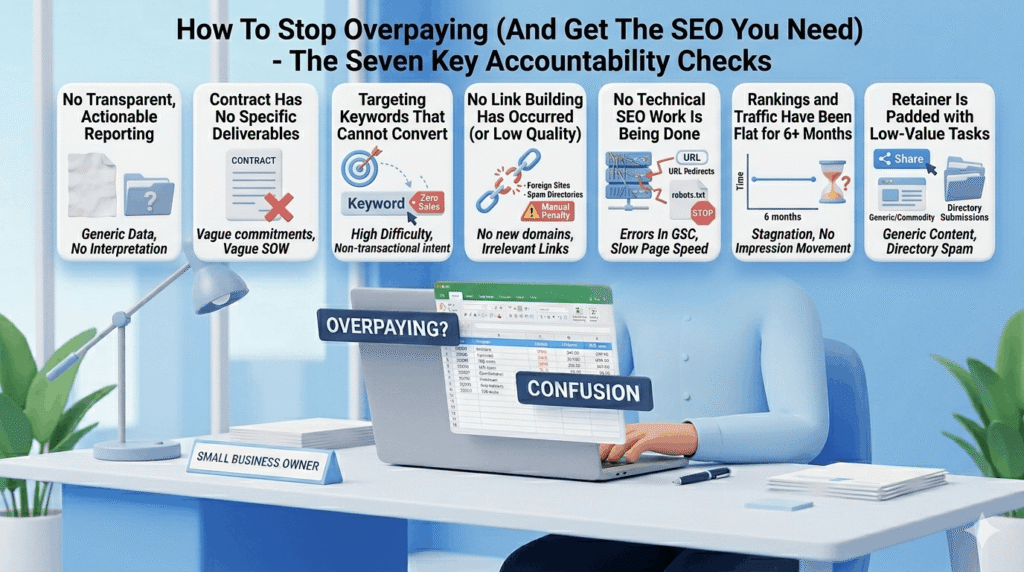
Are you overpaying for SEO services? You likely are if your agency provides vague reports, shows no measurable progress in ranking after six months, engages in zero link-building activity, or charges premium rates for low-value tasks. In 2026, legitimate SEO retainers range from $500 to $8,000/month, depending on scope — and every dollar should be traceable to a specific deliverable or result. Get a Free SEO Audit — we’ll show you exactly where your budget is going and what it’s actually producing. Quick Summary What Does It Mean to Overpay for SEO Services? Overpaying for SEO means spending more money than the delivered work justifies, measured by either the quality of activities performed or the business outcomes produced. It is not simply about the dollar amount — a $5,000/month retainer can represent excellent value if it includes rigorous technical work, high-authority link acquisition, and measurable ranking gains. A $1,000/month retainer can be a waste if it produces nothing traceable. The problem is structural. SEO is an industry with low barriers to entry, no universal certification, and results that take months to appear. This creates a perfect environment for underperformance to hide — and for clients to keep paying long after the relationship has stopped working. What Should SEO Cost in 2026? Engagement Type Monthly Cost Typical Scope Freelancer / solo consultant $500 – $1,500 Local SEO, small site, limited hours Boutique agency (1–10 staff) $1,500 – $3,500 SMB growth, regional competition Mid-size agency $3,500 – $8,000 E-commerce, multi-location, content-heavy Enterprise agency $8,000 – $25,000+ National brands, high-competition verticals In-house SEO specialist (salary) $55,000 – $95,000/yr Full-time, single business focus If your spend sits in one bracket but your deliverables look like a lower bracket, that gap is the overpayment. Sign 1: You Receive No Transparent, Actionable Reporting What does a good SEO report look like? A good SEO report shows keyword-by-keyword ranking changes, organic traffic vs. prior periods, new backlinks acquired, technical issues resolved, and a plain-English plan for the next 30 days. It should take a non-technical reader less than 10 minutes to understand. If your current reporting is a quarterly PDF, an auto-generated dashboard with no interpretation, or a one-line email saying “traffic is up,” you are not getting what you paid for. Reporting is not administrative overhead — it is the accountability mechanism that keeps an agency honest. What to do: Sign 2: Your Contract Has No Specific Deliverables What should an SEO retainer include? An SEO retainer should include defined, measurable deliverables — not vague commitments like “ongoing optimization.” Specifics should cover content output (number of pages or articles), link-building targets (number of new referring domains), technical tasks (list of issues to resolve), and KPIs tied to business goals. Vague language in SEO contracts — phrases like “up to X hours,” “general SEO work,” or “as-needed optimization” — protects the agency, not the client. Without defined scope, there is no basis for accountability, no way to calculate ROI, and no leverage when performance falls short. What to do: Sign 3: They Are Targeting Keywords That Cannot Convert How do I know if my SEO agency is targeting the right keywords? Your agency is targeting the right keywords if they can show you: the keyword’s search volume, its difficulty score relative to your domain authority, and a clear path from ranking for that term to a business outcome (lead, sale, phone call). If they cannot, the keyword strategy is likely wrong. A common agency mistake — sometimes deliberate, sometimes negligent — is to pursue high-volume vanity keywords that look impressive in reports but attract no buyers. Ranking #3 for a 10,000-search-per-month informational term may produce zero revenue if the searcher intent does not align with your offer. Definitions: What to do: Sign #4: No Link Building Has Occurred (or Links Are Low Quality) Why do backlinks matter for SEO? Backlinks are hyperlinks from other websites pointing to your site. They act as votes of credibility in Google’s ranking algorithm — the more authoritative and relevant the linking site, the more ranking power the link passes. Quality link building is one of the most impactful and most often neglected SEO activities. Six months into a retainer with no new referring domains is not a plateau — it is a failure to execute one of SEO’s core functions. Equally dangerous: an agency acquiring dozens of links per month from irrelevant, low-authority, or spammy sites. These links can trigger manual penalties or algorithmic filters that actively suppress your rankings. Step-by-step: How to audit your backlink profile If steps 3–5 reveal little or no legitimate link acquisition, your retainer is not covering this fundamental area — and you are paying for something you are not receiving. What to do: Ask your agency to walk you through their link-building methodology. Acceptable tactics include: digital PR and media outreach, guest posting on relevant industry publications, resource page link acquisition, and building linkable content assets (tools, original research, comprehensive guides). Reject any agency that references “link packages,” “PBNs,” or bulk directory submissions. Contact Us Today to get a free backlink audit and a clear view of whether your current link profile is helping or hurting your rankings. Sign 5: No Technical SEO Work Is Being Done What is technical SEO and why does it matter? Technical SEO refers to optimizations made to a website’s infrastructure — not its content — that help search engines crawl, index, and rank the site correctly. This includes page speed, mobile usability, Core Web Vitals, crawl budget management, structured data, and fixing broken pages or redirect chains. Technical SEO is the foundation. Without it, even excellent content and strong backlinks will underperform because search engines cannot properly access, interpret, or prioritize your pages. Common technical issues that go unaddressed for months in underperforming retainers: What to do: Sign 6: Rankings and Traffic Have Been Flat for 6+ Months How long should it take to see results from SEO? Most websites begin seeing measurable keyword movement within 3 to
Affordable SEO vs Cheap SEO: Key Differences Explained
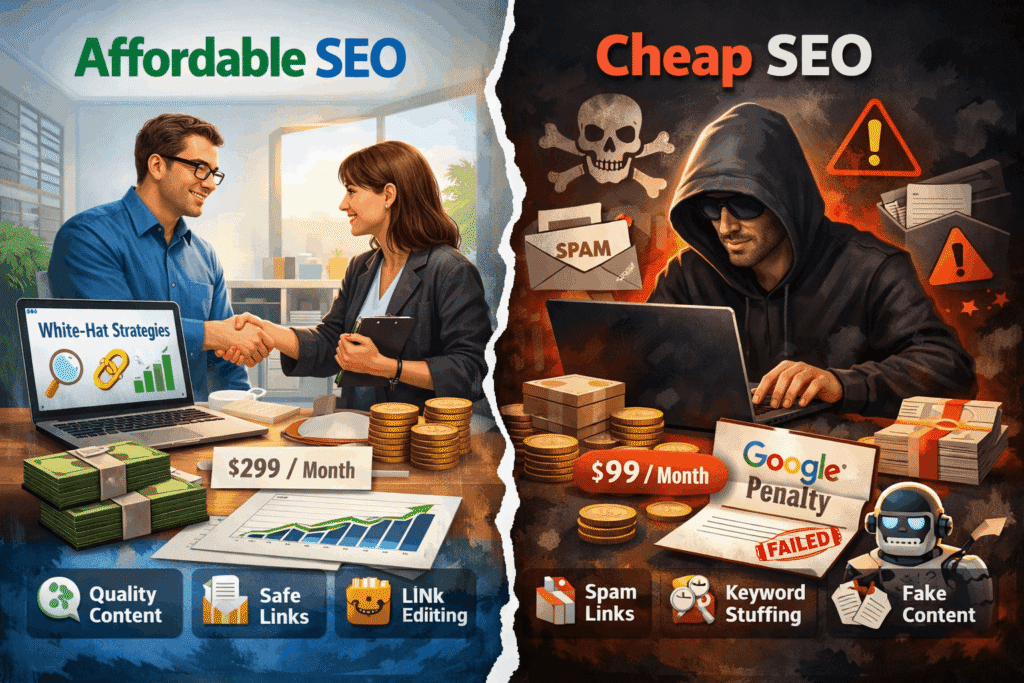
Affordable SEO and cheap SEO are not the same thing. Affordable SEO delivers value for money — using ethical, white-hat strategies that build sustainable rankings over time. Cheap SEO cuts corners with black-hat tactics like keyword stuffing, link spam, and automated content that trigger Google penalties and ultimately destroy your rankings. The core difference is not price — it is quality, ethics, and long-term ROI. Why Small Businesses in the USA Get This Wrong Every week, a small business owner in the USA types ‘cheap SEO services’ into Google and clicks the lowest-priced result. Six months later, their website has been penalized, their rankings have vanished, and they are paying a legitimate agency twice the original price just to undo the damage. The confusion is understandable. When you are running a small business on a tight budget, the words affordable and cheap sound like synonyms. They are not. Understanding the difference between affordable SEO and cheap SEO is one of the most important decisions you will make for your online presence in 2026. This guide breaks it down clearly, without jargon, so you can invest your budget wisely and avoid the traps that derail thousands of small businesses every year. What Is Affordable SEO? Affordable SEO services means getting professional, ethical search engine optimization at a price that fits your business budget — without cutting corners on quality. An affordable SEO provider charges fair rates for the actual work involved: real keyword research, proper on-page optimization, authoritative link building, and consistent performance reporting. Affordable does not mean cheap. It means cost-effective. A business bear $299 to $800 SEO cost per month for a comprehensive SEO strategy is investing in affordable SEO. They are getting measurable deliverables, ethical practices, and compounding results that grow month over month. What Affordable SEO Includes Our Our affordable SEO services for small businesses start at $299/month and include all of the above — no lock-in contracts, no hidden fees. What Is Cheap SEO? Cheap SEO refers to low-cost services that prioritize speed and volume over quality and ethics. These providers typically charge $49 to $149 per month — or offer one-time “packages” promising hundreds of backlinks and guaranteed rankings. The business model behind cheap SEO is simple: automate everything, deliver fast, and move on before the client notices the results are not coming. The tactics used are largely black-hat, meaning they violate Google’s Webmaster Guidelines and can result in manual penalties or algorithmic filtering. What Cheap SEO Actually Does The appeal is obvious. When a small business owner in Dallas or Denver is comparing a $99/month plan versus a $399/month plan, the math looks simple. Until the Google penalty notice arrives. Affordable SEO vs Cheap SEO: Side-by-Side Comparison Factor Affordable SEO Cheap SEO Pricing (USA avg.) $299–$800/month $49–$149/month Strategy Customized to your business and goals Cookie-cutter, one-size-fits-all Link building Manual, white-hat, high-authority Automated, PBNs, link farms Content Original, E-E-A-T optimized, human-written Spun, AI-churned, thin, low-value Keyword targeting Intent-driven research for real users Stuffed for volume, not relevance Reporting Transparent, monthly, data-backed Vague or non-existent Google penalties None — fully compliant practices High risk — can de-index your site Timeline to results 3–6 months (realistic, sustainable) Claims days — delivers nothing lasting Long-term ROI Compounds over time Negative ROI after penalties AI Overview visibility Structured for SGE and LLM citation No optimization for AI search The Real Risks of Cheap SEO for US Small Businesses It is tempting to dismiss cheap SEO as just a bad deal. The reality is worse than that. Cheap SEO can cause lasting damage that takes months and significant budget to reverse. Here is exactly what you risk: 1. Google Manual Penalties Google’s spam team manually reviews websites suspected of violating guidelines. If your site is flagged, it receives a manual action — a notice in Google Search Console informing you that your site has been partially or fully removed from the index. Recovering from a manual penalty requires identifying every problematic link or piece of content, filing a disavow file, and submitting a reconsideration request. This process takes 6 to 12 months on average. 2. Algorithmic Filtering Even without a manual penalty, Google’s core updates — including the Helpful Content System and the Spam Update — algorithmically suppress sites using low-quality content or manipulative link patterns. Your rankings can drop by 70–90% overnight during a core update, with no warning and no easy fix. 3. Invisible in AI Overviews and ChatGPT Google’s AI Overviews (previously Search Generative Experience) and LLM tools like ChatGPT cite authoritative, well-structured sources. Sites built on cheap SEO tactics — thin content, poor E-E-A-T signals, low-authority backlinks — are never cited. In 2026, being invisible in AI search is as damaging as being invisible in organic search. 4. Wasted Budget and Lost Time The average small business that tries cheap SEO and then switches to a legitimate provider has spent 6 to 18 months and $600 to $2,600 on services that delivered zero results or active harm. That is budget and time that could have been compounding with a real strategy. How to Tell the Difference Before You Sign Cheap SEO providers are skilled at marketing themselves as affordable. Here are the specific signals that separate a legitimate, affordable SEO agency from a cheap one: Red Flags of Cheap SEO Green Lights of Affordable SEO What Does Affordable SEO Actually Cost in the USA in 2026? One of the most common questions from US small business owners is: how much should I realistically pay for SEO? Here is the honest answer based on real market data: Budget Range What You Get Appropriate For Under $150/month Red flag territory — likely cheap SEO Avoid $175–$350/month Entry-level legitimate SEO, core optimizations New sites, very local markets $299–$600/month Solid affordable SEO: on-page + content + reporting Most US small businesses $600–$1,200/month Full-service SEO: technical seo, content, link building Competitive local/national markets $1,200+/month Enterprise-grade or aggressive multi-location campaigns Established businesses scaling fast Our on-page SEO services, local SEO services, and
How Much Does SEO Cost for a Small Business in 2026? (Full Breakdown)
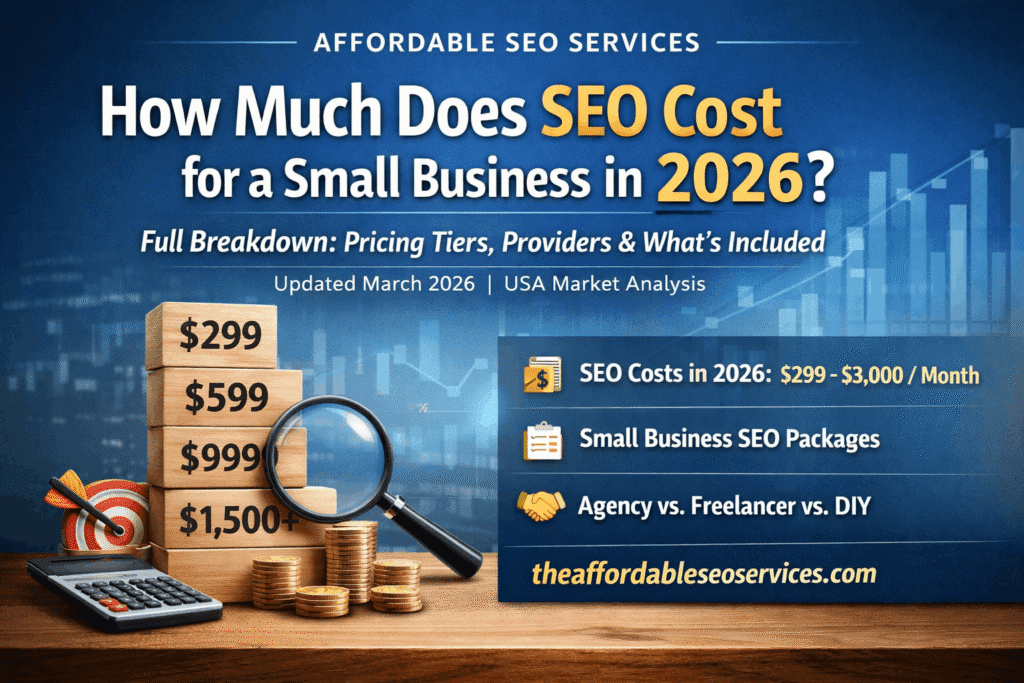
SEO for a small business in the USA costs $299–$3,000 per month in 2026, depending on the scope of work, your market’s competition, and who you hire. Most small businesses fall between $500–$1,500/month for a professional ongoing campaign. Anything under $299/month from a legitimate provider is rare — and anything over $3,500/month is typically mid-size agency or high-competition industry territory. If you want a single number to plan around: a well-structured local SEO campaign from a specialized small business SEO provider starts at around $299–$599/month and scales from there based on your market. What Actually Determines Your SEO Cost Before requesting a quote, understand why two businesses in the same city can get completely different pricing. Five variables drive your cost — and they matter more than which agency you call. SEO Pricing Models Explained Monthly Retainer (Most Common) Fixed monthly fee for defined deliverables — keyword research, on-page optimization, content, link building, and reporting. The right model for small businesses because SEO requires consistent, compounding effort. One-time work does not hold rankings. Typical range: $299–$3,000/month for small businesses Hourly Consulting Best for businesses with an in-house team that needs expert guidance on a specific issue — a technical audit, site migration review, or strategy session. Typical range: $100–$300/hour Project-Based SEO A defined deliverable with a clear start and end — a full technical audit, migration plan, or content architecture build. Projects often transition into a monthly retainer. Typical range: $500–$10,000 per project Performance-Based SEO You pay based on ranking improvements or traffic growth. In 2026, reputable providers rarely offer pure performance models — the incentive often pushes toward easy-to-rank, low-value keywords rather than terms that drive revenue. Treat this with caution unless it’s a hybrid model with a base retainer. What You Get at Each Price Point Under $299/month — Not Recommended At this price most providers use automated tools, do minimal work, or lock you into vague contracts. Meaningful ranking movement is unlikely. Some basic citation work is possible but this is not a sustainable professional campaign. $299–$599/month — Entry-Level Professional Where a real service begins. At this budget: keyword research, on-page optimization for core pages, local SEO including Google Business Profile management, and basic technical fixes. The Starter Growth Plan at $299/month covers a site audit, 5–8 keywords, on-page SEO for 5 pages, technical basics, and Google Search Console setup. Best for: Single-location businesses in smaller or low-competition US markets $599/month — Full Small Business Campaign A complete ongoing campaign with keyword research, on-page SEO for up to 10 pages, link building (4–6 backlinks/month), local SEO, and monthly strategy reporting. This is where competitive local rankings become achievable. Best for: Most US small businesses in competitive local markets $999/month — Comprehensive Growth Advanced competitor analysis, 20–30 keyword targets, full on-page SEO across up to 20 pages, advanced technical SEO, and 8–10 authority backlinks per month. Appropriate for competitive industries or businesses targeting multiple cities. Best for: Businesses needing aggressive, measurable growth with detailed monthly strategy reviews $1,500–$3,000/month — High-Competition Industries Personal injury law, cosmetic surgery, real estate, financial services — industries where one client is worth tens of thousands of dollars require aggressive strategies. At this level, most businesses work with larger agencies with full teams. $3,500+/month — Enterprise and National SEO National keyword targeting or multi-location management. Enterprise agency territory. Not where most small businesses need to operate. Quick Reference: SEO Cost Summary (USA 2026) Budget / Plan What You Get Best For Under $299/month Basic setup, automated tools, minimal strategy Not recommended for results $299/month — Starter Audit, 5–8 keywords, on-page SEO (5 pages), technical basics, GSC setup New/small websites, low competition markets $599/month — Standard 10–15 keywords, on-page (10 pages), local SEO, 4–6 backlinks/month, reporting Most US small businesses, competitive local markets $999/month — Premium 20–30 keywords, on-page (20 pages), advanced technical SEO, 8–10 backlinks/month, competitor analysis Competitive industries, multi-city targeting $1,500–$3,000/month High-competition full-service campaigns, larger agency teams Law, healthcare, finance, national targeting $100–$300/hour Consulting, one-off audits, strategy sessions In-house teams needing expert guidance $500–$10,000 (project) Audits, site migrations, content strategy Specific deliverable without ongoing retainer Agency vs. Freelancer vs. DIY: Real Cost Comparison Hiring a Specialized SEO Agency Monthly cost: $299–$3,000+ depending on scope. A team covering technical SEO, content, link building, and reporting — no single-person bandwidth constraint. Agencies built specifically for small businesses, like Affordable SEO Services, deliver the same results as large agencies at a fraction of the cost because they are structured to serve that market efficiently. Hiring a Freelancer Monthly cost: $300–$2,000. Specialized skills at a lower price. The limitation is bandwidth — one person rarely covers technical SEO, content production, and link building simultaneously at a high level. Building an In-House SEO Team Annual cost: $70,000–$90,000 per SEO specialist salary (US average 2026), before tools, training, and overhead. A full in-house team runs $250,000–$500,000+ annually. Only practical for businesses with significant organic traffic dependency. DIY SEO Monthly cost: $100–$500 in tools (Ahrefs or Semrush start at $99–$199/month). The real cost is your time. A free SEO audit can show you specific issues on your site — helping you decide whether DIY is realistic or professional help will move the needle faster. What a Legitimate SEO Package Must Include in 2026 Regardless of provider or model, these are non-negotiables for a real SEO campaign: Important: No legitimate provider will guarantee #1 rankings. Nobody controls Google’s algorithm. Platform-Specific SEO Costs WordPress SEO Configuration of Rank Math or Yoast, permalink structure, WooCommerce SEO, and Core Web Vitals fixes are common WordPress-specific needs. Our WordPress SEO services handle the platform-specific technical layer that generic SEO packages often miss. Shopify SEO Canonical tag issues, duplicate product URL problems, collection page SEO, and product schema are Shopify-specific challenges. Our Shopify SEO services address exactly these — not generic e-commerce SEO repackaged. How Long Before SEO Produces Results? Key insight: The businesses winning on Google today started 12–18 months ago. Every month a competitor with consistent SEO extends their lead. SEO Cost vs. Google Ads: The Honest Comparison In
What Are Affordable SEO Services for Small Businesses? (Complete Guide 2026)

Affordable SEO services for small businesses are professional search optimization solutions — covering keyword research, on-page optimization, local SEO, technical fixes, link building, and AI search visibility (GEO) — that typically cost between $500 and $1,500 per month for meaningful, sustainable results. They are fundamentally different from “cheap” SEO: affordable means value-driven, ethical, and measurable. Cheap means shortcuts that can get your site penalized and take months to recover from. Why SEO Still Matters for Small Businesses in 2026 Before spending a dollar, understand what has changed. Search in 2026 is not what it was in 2023. Gartner’s latest forecast projects that 25% of all web search traffic will shift away from traditional search engines to AI-powered answer engines by the end of 2026. When a potential customer asks Chat GPT “best plumber near me” or “most trusted accountant in Austin,” AI tools generate a synthesized answer — citing specific businesses by name. If your business is not cited, you are invisible to a fast-growing share of searchers. Search behavior is evolving: customers no longer just search “plumber near me” — they want an SEO approach that understands AI search, voice queries, and how to drive real revenue, not just empty clicks. The good news: SEO is one of the most cost-effective marketing strategies for small businesses because the traffic it generates is organic and compounding. Unlike paid ads, which stop the moment you stop paying, organic and AI-citation rankings keep working for you around the clock. What Does “Affordable SEO” Actually Mean in 2026? The word “affordable” is weaponized by bad actors in this industry. Let’s define it properly. Affordable SEO prioritizes ethical practices, transparent pricing, and measurable results — while cheap SEO relies on shortcuts that often lead to penalties and wasted investment. Walk away from any “full SEO” offer under $200/month. At this price, most providers either use automated tools that produce spammy work, do almost nothing at all, or lock you into long contracts with vague deliverables. Cheap SEO can actually damage your Google rankings through toxic backlinks and thin content — damage that takes months to recover from. The real distinction: affordable SEO gets you a sustainable competitive advantage. Cheap SEO creates a liability. How Much Do Affordable SEO Services Cost in 2026? The market in 2026 has solidified around clear pricing tiers. Here is how it actually breaks down: SEO for US small businesses typically costs $500–$3,000 per month for ongoing services. Most small businesses land at $1,000–$2,500/month. Anything under $500/month rarely produces real results. Small businesses can findlocal SEO services starting at $500, but efficient solutions delivered by experts start from $1,600. Local SEO cost directly depends on your business size, market competition, number of locations, agency reputation, and the software involved. Monthly Budget What You Get Best Fit Under $300 DIY with paid tools only Solo founders with time to learn $300–$500 Freelancer: GBP + basic on-page Single-location, low-competition $500–$1,000 Small agency: local SEO + content + reporting Growing local businesses $1,000–$1,500 Full-service affordable: strategy + content + links + technical Competitive local/regional markets $1,500–$3,000 Mid-tier agency: full-service including GEO Multi-location or e-commerce Pricing by model: Model Typical Cost Best For Monthly Retainer $500–$2,500/month Ongoing growth Project-Based $1,000–$5,000 one-time Audits, site migrations Hourly Rate $75–$300/hour Specific technical fixes Freelancer $500–$1,000/month Lean budgets, less competition The hourly rate model ranges from $15 to $250, depending on whether you work with a freelancer or a company. Professional SEO agencies typically don’t offer hourly rates because it leads to value miscalculations — an expert can accomplish in one hour what a freelancer takes days to do. The 6 Core Services Every Affordable SEO Package Must Include Not every SEO package is built the same. Before signing anything, confirm these six components are explicitly included. 1. SEO Audit — The Non-Negotiable First Step Every legitimate engagement starts here. Start with free essentials: Google Search Console, Ahrefs Webmaster Tools, and Bing Webmaster Tools. For more advanced insights, consider affordable options like SEMRush, Ubersuggest, SurferSEO, or Ahrefs Lite. An seo audit identifies what is broken technically, what keywords you can realistically win, and what your competitors are doing better than you. Without it, every dollar spent afterward is guesswork. 2. Google Business Profile (GBP) Optimization For any business serving customers locally, this is the single highest-ROI action available. GBP optimization directly drives local calls, website clicks, and in-person visits from customers in your area. 78% of “near me” searches result in offline purchases, making Google Business optimization a top priority for small businesses. A fully optimized GBP — with complete service descriptions, photos, Q&A, posts, and consistent review responses — is often the fastest path to new customers. 3. On-Page and Technical SEO This covers your actual website: title tags, meta descriptions, H1/H2 structure, internal linking, page speed, mobile responsiveness, Core Web Vitals, and crawlability. A major warning sign is when an agency works without requesting access to essential tools like Google Analytics, Search Console, or your CMS — legitimate SEO requires integration with these platforms. If an agency does not need access to these, they are not doing real on-page work. 4. Local SEO and Citation Building Local SEO targets geographically qualified searches — “dentist in Chicago,” “emergency plumber near me.” This includes consistent NAP (Name, Address, Phone) data across all directories, local citation building, and map pack optimization. This is where small businesses can outrank large national competitors. 5. Content Creation and Topical Authority In 2026, AI-written fluff is everywhere. If your SEO partner suggests churning out 100 blog posts a month using basic AI prompts without human editing or E-E-A-T principles, your rankings will eventually crater. Search engines now prioritize helpful content — if the agency does not have a robust editorial process or subject matter experts, they are just adding to the digital noise. Good affordable SEO includes two to four well-researched, original, human-edited pieces of content per month — each one built to answer a specific question your customers are actively searching