
You’re staring at a cold email from an SEO agency. They want $400/month. Sounds affordable SEO services — but you’ve been burned before. You paid a Fiverr gig, got a 40-page PDF report, and your phone stayed silent.
So is sub-$500 SEO real? Or is it always a trap?
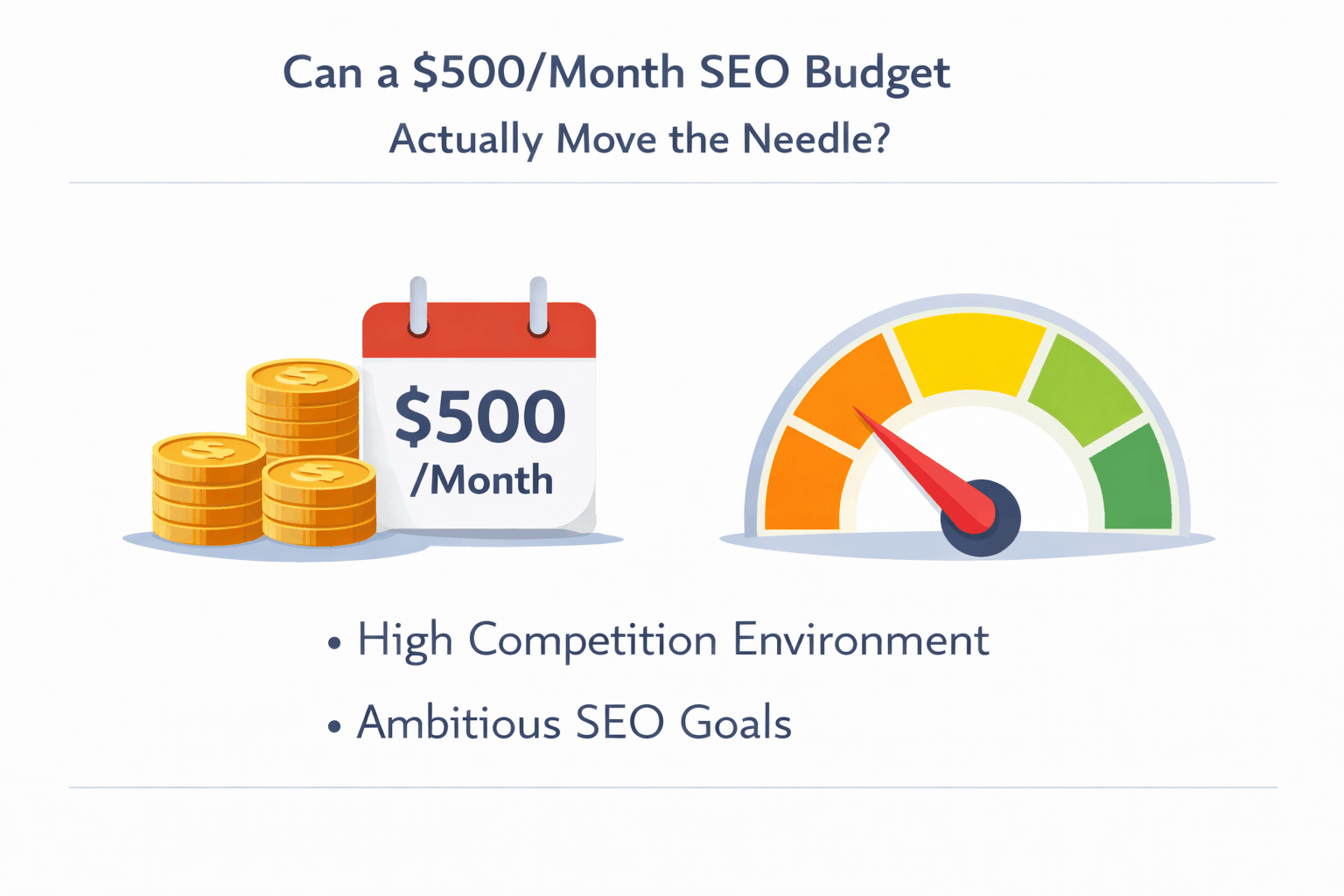
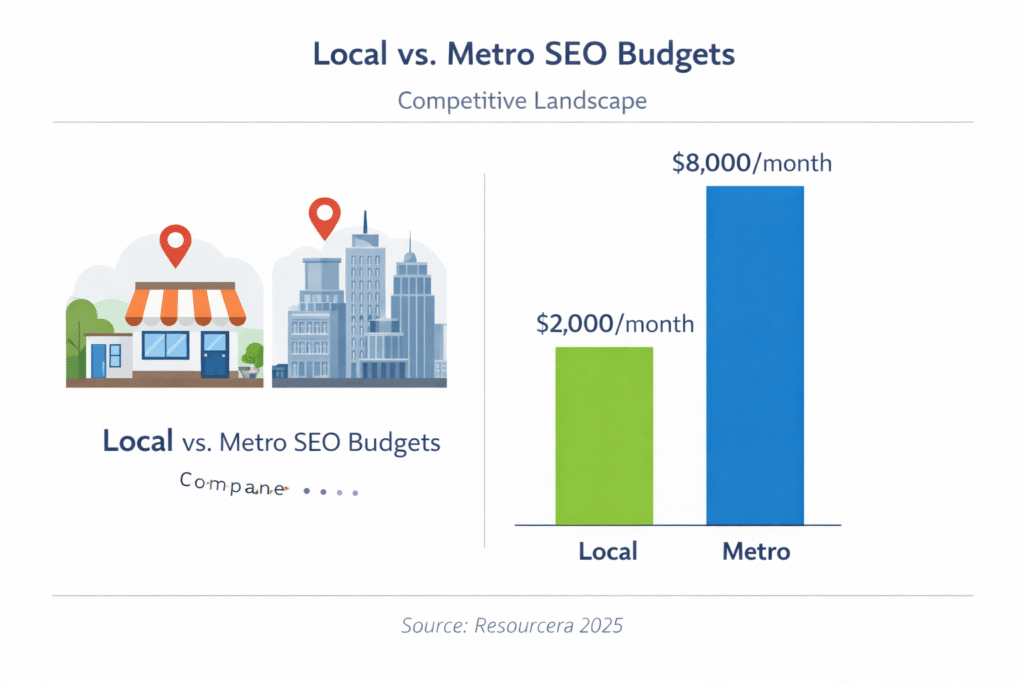
Here’s the honest answer: it depends on one thing more than anything else — your competitive environment. In a low-competition local market, $500/month can genuinely move rankings. In a competitive metro market or a cutthroat industry, that same $500 mostly covers an agency’s overhead and not much else.
Let’s break down exactly what that means for your business.
What “SEO Under $500/Month” Actually Buys You
Can you get SEO results for under $500/month? Yes — but only under specific conditions. At this budget, you’re typically getting Google Business Profile optimization, basic on-page fixes, and light local citation work. That’s enough to shift rankings for low-competition local keywords. It won’t fund a content program, serious link building, or technical SEO at any meaningful scale.
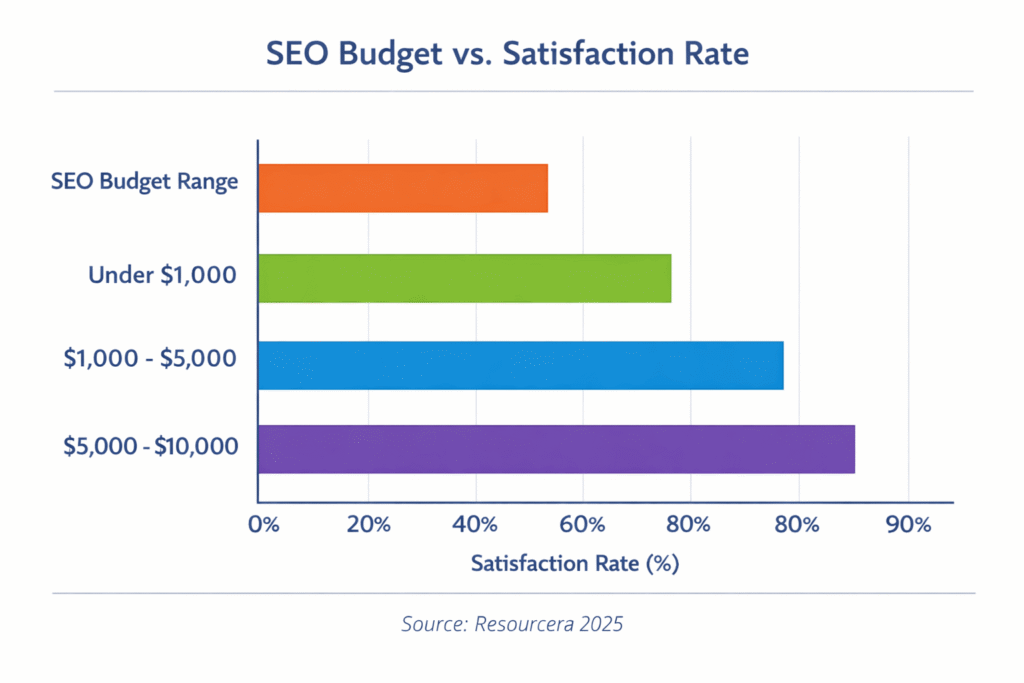
According to a 2026 industry report by Resources, businesses spending only around $500/month on SEO are 75% more likely to be dissatisfied compared to those investing more. That’s a damning stat — but read it carefully. It says “more likely,” not “guaranteed to fail.” The businesses in that 75% are often in the wrong markets for that budget, paying the wrong providers, or expecting results in 60 days instead of 6 months.
Quick note: $500/month is the entry point of the industry, not a sweet spot. Ahrefs’ pricing research and Search Engine Journal’s 2024 State of SEO report both peg the average small business SEO retainer at $1,000–$3,000/month. You’re operating below the industry floor. That changes what’s possible — not impossible, just limited.
The Two Scenarios Where Sub-$500 SEO Can Work
This is what most articles skip entirely.
Both competitor articles we reviewed focused almost exclusively on why cheap SEO fails. That’s fair. But it leaves small business owners with zero actionable path forward — and that’s not useful.
Scenario 1: Low-competition local markets
An affordable seo services small business like plumber in a town of 30,000 people targeting “emergency plumber [city name]” is not competing against 500 other optimized websites. They might be competing against three. In that context, a cleaned-up Google Business Profile, consistent NAP citations, and two decent service pages can — and does — produce real first-page results.
Look — if you’re a single-location service business in a non-metro area with one or two competitors who haven’t touched their websites since 2019, here’s what actually works: invest the $500 entirely in local SEO fundamentals. Don’t spread it thin.
Scenario 2: DIY with paid tools
Semrush’s Pro plan runs ~$140/month. Ahrefs Starter is $29/month. With $200–$300 in tools and the remaining budget on one well-optimized page per month, a business owner with 5–6 hours per week can build real traction — slowly. This isn’t for everyone. It demands consistency and a learning curve. But it’s a legitimate path.
When $500/Month Will Not Work — Be Honest With Yourself
Some markets are just expensive. A personal injury lawyer in a major city, a cosmetic dentist competing against 30 practices in a metro area, or any e-commerce brand going head-to-head with funded competitors — these are not $500/month SEO problems. They never were.
Here’s the thing: the issue isn’t that cheap SEO is always fraudulent (though some of it is). The issue is budget-market mismatch. Spending $500 in the wrong arena is like bringing $20 to a poker table with a $500 minimum buy-in. You’re not just unlikely to win — you’re not really even playing.
Quick Comparison: What Budget Works for Which Situation
| Situation | Budget Realistic? | Why |
|---|---|---|
| Local service, small town, 1–3 competitors | $300–$500/month | Low competition, fundamentals dominate |
| Local service, mid-sized city | $750–$1,500/month | More competition, needs content + links |
| Regional/national keyword targets | $2,000–$5,000/month | High competition, needs full-stack SEO |
| E-commerce or highly competitive vertical | $3,000–$10,000+/month | Scale and link authority required |
What to Actually Do If $500 Is Your Real Ceiling
Or maybe I should say it this way: the question isn’t just “does $500 work?” — it’s “how do I squeeze the most ROI from this budget right now?”
Step-by-step prioritization for sub-$500 SEO:
- Claim and fully optimize your Google Business Profile — it’s free and drives local pack rankings more than almost anything else at this budget level
- Fix your top 3 service pages — proper title tags, one target keyword per page, updated content, mobile speed check
- Get consistent citations — make sure your name, address, and phone number match exactly across Google, Yelp, and your top 5 local directories
- Write one piece of genuinely useful local content per month — not keyword-stuffed filler, but a real answer to a question your customers ask
- Track everything from day one — Google Search Console is free; without data, you can’t prove (or improve) anything
That’s it. That’s the sub-$500 playbook. Simple — but only effective if your market allows it.
Most people assume that more tactics = more results. The data says otherwise. At this budget, focus and consistency beat breadth every single time.
The Risk Nobody Warns You About: Bad Cheap SEO vs. No SEO
Some experts argue that any SEO is better than none. That’s valid for legitimate budget providers doing honest work. But if you’re dealing with an agency using automated link spam, keyword stuffing, or black-hat tactics — you’re not buying slow progress, you’re buying a future penalty.
I’ve seen conflicting data on how long Google penalties take to surface — some sources say months, others say algorithm updates can trigger them years later. My read is this: the risk of bad cheap SEO isn’t just wasted money, it’s a damaged domain that costs 3–6 months of cleanup work before you can even start building.
Fiverr gigs under $50, “500 backlinks for $10” offers, and agencies promising page-one rankings in 30 days are not budget SEO. They’re liability.
What most guides skip is the middle ground: there are legitimate freelancers and small agencies who charge $400–$600/month and do honest, focused local SEO work. They exist. They’re just harder to find than the scam operations that dominate search results for “cheap SEO.”
Voice Search Q&A
Q: What’s the best way to do SEO with a small budget?
Focus entirely on Google Business Profile optimization and fixing your core service pages first. In low-competition local markets, these two steps alone can move rankings within 90 days without spending more than $300–$500/month.
Q: How do I know if $500/month is enough for my SEO?
Search your main keyword in incognito mode and count how many of your competitors have optimized websites with active content. If fewer than five do, $500/month can work. If all 10 results are polished and current, your budget needs to increase.
Q: Should I hire an agency or do SEO myself on a low budget?
If your budget is genuinely under $500, doing it yourself with tools like Semrush or Ahrefs will likely outperform hiring a cheap agency — provided you commit 5–10 hours per week consistently.
Q: Why does cheap SEO usually fail?
Most sub-$500 agency packages don’t include real content creation, link building, or technical fixes. You’re often paying for reports and automated tools, not strategy or execution.
Q: When should I increase my SEO budget?
When you’ve maxed out local fundamentals (GBP optimized, citations clean, top pages fixed) and you’re still not ranking — that’s the signal. Throwing more money at fundamentals you’ve already done won’t help; a bigger budget buys new levers.