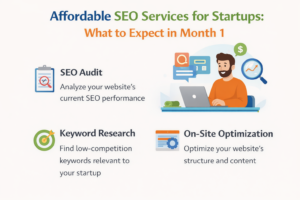

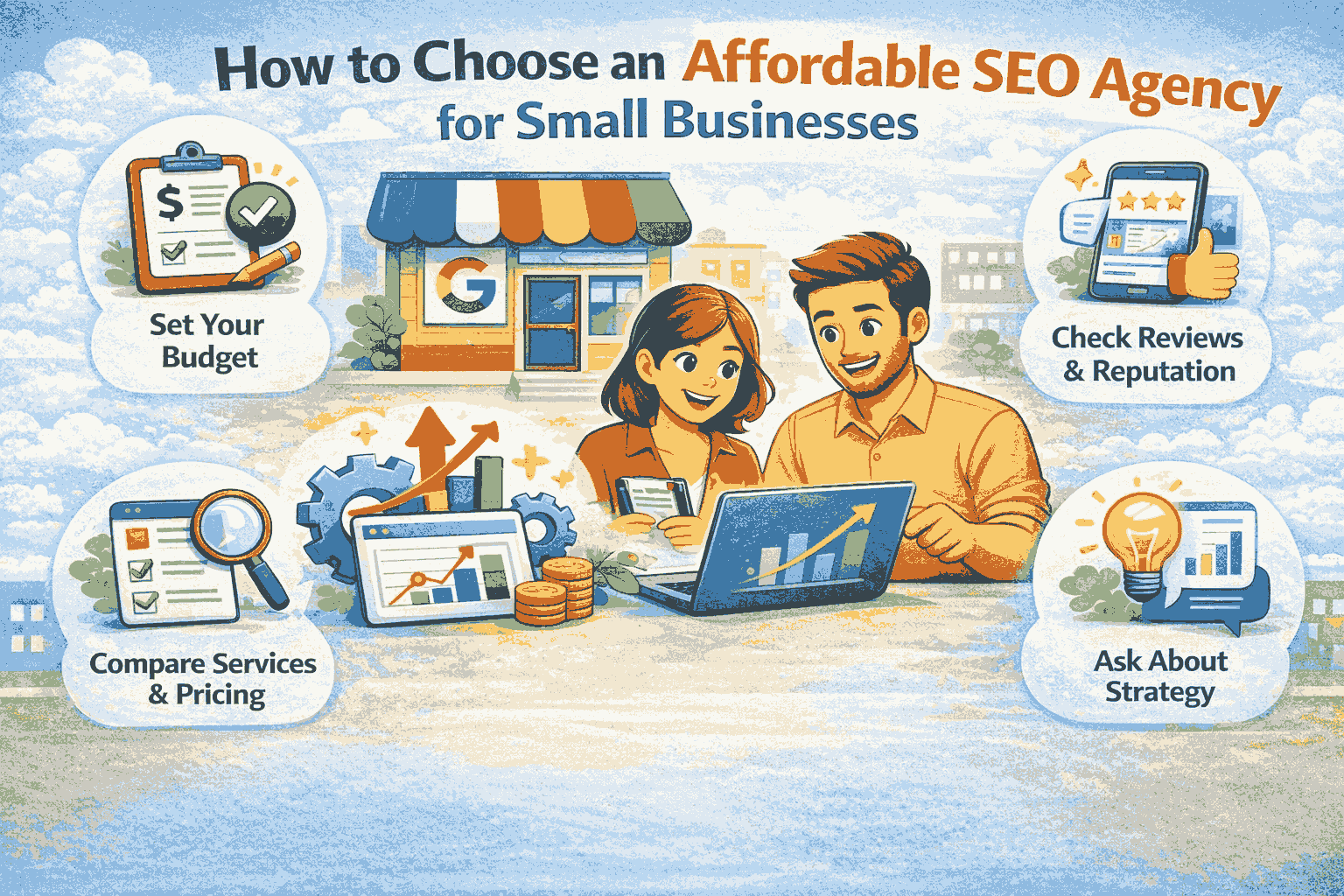
You’ve probably already sat through a sales call where the agency rep said a lot of words — “domain authority,” “technical audit” “link velocity” — and quoted you $2,500/month with no clear breakdown. You’re not alone.
Here’s what most guides won’t tell you: the problem isn’t that affordable SEO agencies don’t exist. The problem is that most small business owners don’t know how to tell a legitimate budget agency from one that’ll disappear after month three.
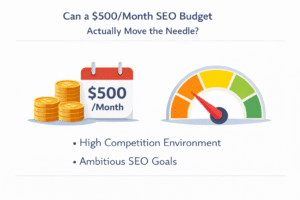
What does ‘affordable SEO agency‘ mean? An affordable SEO agency for small businesses provides core optimization services — keyword targeting, on-page SEO, local listings, and basic link building — at monthly rates typically between $300 and $1,000. These agencies serve businesses that can’t justify enterprise pricing but still need measurable organic growth.
Why Small Business SEO Pricing Is So Confusing
There’s no industry-standard pricing sheet. None. An agency in Austin might charge $400/month for the same deliverables another agency in Chicago prices at $1,800/month.
According to Bright Local’s 2024 Local Consumer Review Survey, 76% of small business owners report difficulty measuring ROI from SEO spend — making transparent monthly reporting the #1 factor in agency satisfaction. That stat matters because it exposes the real problem: most startup owners are paying for outputs they can’t evaluate.
Most agencies bill for “hours” or “tasks” instead of outcomes. A vague deliverable list — “20 blog posts, 50 backlinks, monthly reporting” — tells you nothing about whether the work will actually move your rankings.
Here’s the thing: price alone is a terrible filter. A $400/month retainer from an experienced local SEO specialist can outperform a $1,500/month package from a large agency that assigns your account to a junior coordinator.
5 Questions to Ask Before Signing Any SEO Contract
Before you request a proposal, run every agency through these five questions. Weak answers — or evasive ones — are your signal to walk.
To evaluate an affordable SEO agency, ask these five questions:
- 1. Can you show me a client ranking report from the last 90 days? Real agencies have real data. If they can’t or won’t show you anonymized client results in tools like Semrush or Google Search Console, stop there.
- 2. What happens to my rankings if I cancel? Some agencies build rankings on rented infrastructure — local citations they own, private blog networks, etc. If the answer sounds vague, that’s a problem.
- 3. Will you set up Google Search Console on day one? This is the free, official tool every legitimate agency uses. Any agency that can’t answer yes immediately is a red flag.
- 4. How do you build backlinks? Acceptable answers: outreach, HARO, local press, directory submissions. Unacceptable: “proprietary network,” “guaranteed placements,” or anything involving bulk purchases.
- 5. What does your monthly report include? You should see keyword movement, traffic changes, and completed tasks — not just a list of articles published.
Or maybe I should say it this way: if an agency can’t answer these five questions in plain English, they’re not the right partner for a small business. Transparency isn’t optional at this budget level.
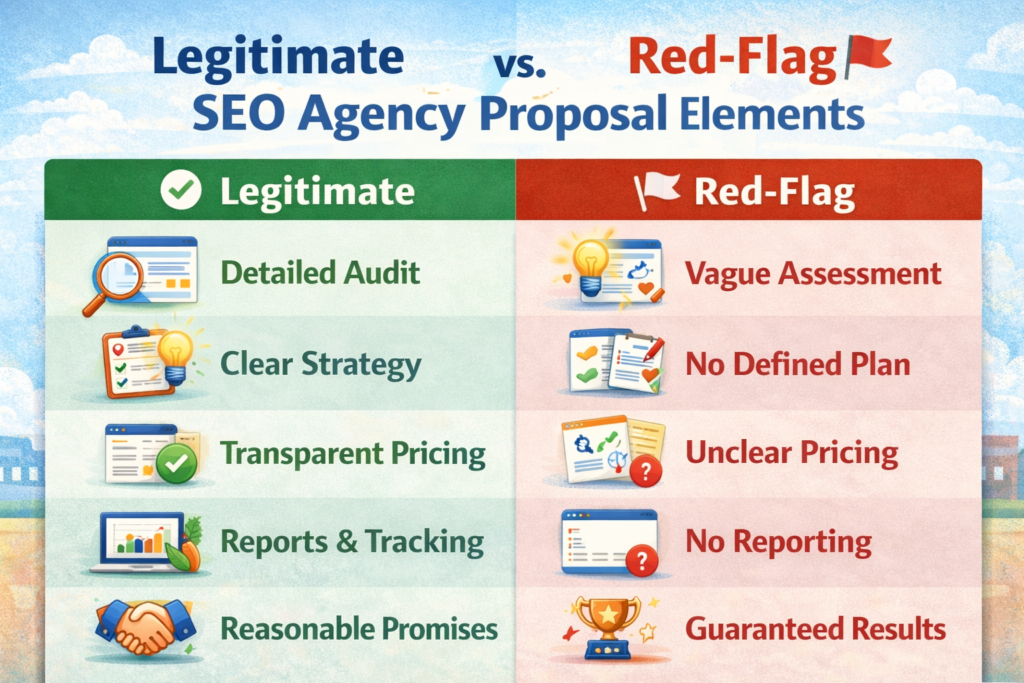
Red Flags That Most SEO Guides Don’t Cover
This is the section Thrive and MozWebMedia skip. Both list agency names — neither walks you through how to verify the agencies they recommend. That’s a real gap for a non-technical business owner.
Guaranteed Rankings Promises
No legitimate SEO agency guarantees specific rankings. Google’s algorithm changes hundreds of times a year. Any agency promising “#1 on Google in 60 days” is either lying or planning to use tactics that’ll get your site penalized.
Walk away. Every time.
Fake or Unverifiable Case Studies
Here’s a quick verification move: when an agency shows you a case study, ask for the client’s domain name. Then check it yourself in Moz’s free Domain Overview tool or a free Semrush trial. Do the traffic and authority numbers match their claims?
Some agencies show screenshots of rankings for made-up or obscure keywords — “best blue widgets in Springfield” — that get zero searches per month. That’s called vanity keyword targeting, and it’s designed to make you feel like progress is happening.
No Mention of Google Search Console
Search Console is free. It’s the baseline tool Google provides to every website owner. If an agency’s onboarding process doesn’t include configuring Search Console as step one, that tells you a lot about how seriously they treat transparency.
Quick Comparison: What Different SEO Budget Tiers Actually Get You
Some experts argue that small businesses should always go for the cheapest possible option to test before committing. That’s valid when you have no data. But if you’ve already wasted money on a $199/month package, you know firsthand that price floor matters.
| Budget Range | Best For | Key Benefit | Limitation |
| $200–$400/mo | Solo freelancer or startup | Low risk to test basics | Limited bandwidth, no team depth |
| $400–$800/mo | Local service businesses | Full local SEO + reporting | Less content production |
| $800–$1,200/mo | E-commerce SEO or multi-location | Link building + content strategy | Still limited vs. enterprise tools |
| $1,500+/mo | Competitive national niches | Dedicated account team | Budget may be too high for early stage |
Freelancer vs. Agency: A freelance SEO specialist is better suited for early-stage businesses with tight budgets because the cost structure is leaner and communication is direct. A small agency works better when you need content production, link outreach, and technical fixes handled simultaneously. The key difference is bandwidth — one person can only manage so many moving parts.
How to Verify an Agency’s Results Before You Sign
Most guides stop at “ask for case studies.” That’s not enough. Here’s an actual verification process you can run in under 30 minutes, no technical experience required.
- Step 1: Ask for an anonymized client URL from a business similar to yours — same size, same niche if possible.
- Step 2: Run the URL through Semrush’s free traffic checker or Moz’s free Domain Overview. Look for consistent growth, not a spike followed by a cliff.
- Step 3: Check the site’s backlink profile using the same tools. Are the links from real, relevant websites? Or from unrelated foreign directories and private blog networks?
- Step 4: Google a few of their claimed keywords and see if the client site actually ranks — not just somewhere on page 8.
- Step 5: Ask the agency to walk you through the results live, not from a screenshot. If they can’t share their screen and pull live data, consider that a yellow flag.
I’ve seen conflicting data on this — some sources say a simple case study review is sufficient due diligence, others recommend full audits. My read is that the five-step live walkthrough gets you 90% of the confidence you need without requiring any technical expertise.
What a Fair Affordable SEO Package Actually Includes
Look — if you’re a local dentist or a regional HVAC company, here’s what actually works at the $400–$800/month range:
- Keyword research tied to services you actually offer — not broad terms you’ll never rank for in year one
- On-page optimization of your top 5–10 service or product pages
- Google Business Profile management for local visibility
- Monthly reporting via Google Search Console showing real keyword and traffic movement
- 2–4 content pieces per month, minimum — targeting long-tail keywords with realistic ranking potential
- Local citation building in relevant, legitimate directories (not bulk submissions)
What you should not expect at this budget: aggressive national link outreach campaigns, dedicated content writers producing 20 pieces a month, or weekly check-in calls with a senior strategist. Those are enterprise-tier deliverables.
The Bottom Line
Choosing an affordable SEO agency isn’t about finding the lowest monthly rate. It’s about finding a team whose results you can verify, whose strategy you understand, and whose reporting actually shows you what’s moving.
The small businesses that get burned by bad SEO agencies all share one trait: they made their decision based on price and a polished sales pitch. The ones that get real results? They asked hard questions — and walked away when they didn’t get straight answers.
Run the five-question vetting process. Check the client data yourself using Semrush or Moz. Make sure Google Search Console is part of day-one onboarding. That’s the entire framework. Everything else is noise.
Common Questions About Hiring Affordable SEO Agencies
Q: What’s the best affordable SEO agency for a small business in the USA?
There’s no single best option — it depends on your niche, location, and budget. Instead of chasing a name brand, use the five-question vetting framework above to evaluate any agency you’re considering. The right agency is one that shows you real client results and explains their strategy in plain English.
Q: How do I know if an SEO agency is actually affordable or just cheap?
“Affordable” means fair value for the deliverables — local SEO, reporting, content, and basic link building for $400–$800/month. “Cheap SEO” means a low price with vague or automated deliverables that won’t move your rankings. The difference shows up in the contract and the reporting.
Q: Should I hire an SEO freelancer or an agency for my small business?
For most small businesses under $700/month, a vetted freelance SEO specialist often delivers better ROI than a small agency, simply because there’s no overhead markup. An agency makes more sense when you need content, technical work, and outreach happening simultaneously.
Q: Why does SEO pricing vary so much between agencies?
Because there’s no standardized pricing in the SEO industry. Cost differences reflect overhead, experience level, and the specific deliverables included. The safest approach is to compare line-by-line deliverables across proposals — not just the monthly total.
Q: When should I walk away from an SEO agency proposal?
Walk away immediately if the agency promises guaranteed rankings, can’t show you real client data, doesn’t mention Google Search Console in their onboarding process, or proposes a contract with no clear monthly deliverables listed.