

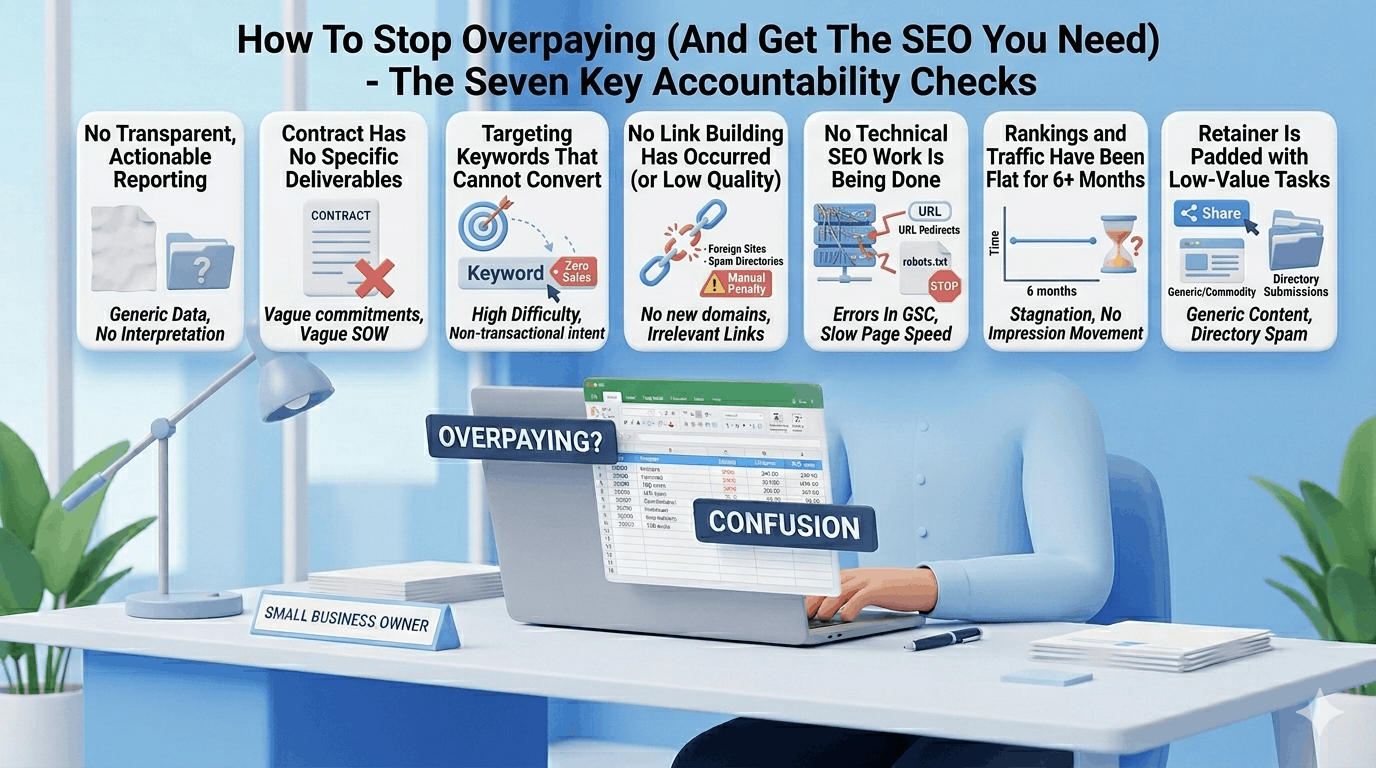
Are you overpaying for SEO services? You likely are if your agency provides vague reports, shows no measurable progress in ranking after six months, engages in zero link-building activity, or charges premium rates for low-value tasks. In 2026, legitimate SEO retainers range from $500 to $8,000/month, depending on scope — and every dollar should be traceable to a specific deliverable or result.
Get a Free SEO Audit — we’ll show you exactly where your budget is going and what it’s actually producing.
Quick Summary
- You are likely overpaying for SEO if reports are vague, deliverables are undefined, or rankings have been flat for 6+ months.
- Fair SEO pricing in 2026 ranges from $500/month (freelancer, local) to $8,000+/month (enterprise agency).
- The highest-value SEO activities are technical audits, quality link acquisition, and intent-driven content — not social sharing or directory submissions.
- A 5-step self-audit using Google Search Console and Ahrefs can reveal the truth about your current spend in under an hour.
- The fix is not always switching providers — sometimes renegotiating scope and deliverables is enough to dramatically improve ROI.
What Does It Mean to Overpay for SEO Services?
Overpaying for SEO means spending more money than the delivered work justifies, measured by either the quality of activities performed or the business outcomes produced. It is not simply about the dollar amount — a $5,000/month retainer can represent excellent value if it includes rigorous technical work, high-authority link acquisition, and measurable ranking gains. A $1,000/month retainer can be a waste if it produces nothing traceable.
The problem is structural. SEO is an industry with low barriers to entry, no universal certification, and results that take months to appear. This creates a perfect environment for underperformance to hide — and for clients to keep paying long after the relationship has stopped working.
What Should SEO Cost in 2026?
| Engagement Type | Monthly Cost | Typical Scope |
|---|---|---|
| Freelancer / solo consultant | $500 – $1,500 | Local SEO, small site, limited hours |
| Boutique agency (1–10 staff) | $1,500 – $3,500 | SMB growth, regional competition |
| Mid-size agency | $3,500 – $8,000 | E-commerce, multi-location, content-heavy |
| Enterprise agency | $8,000 – $25,000+ | National brands, high-competition verticals |
| In-house SEO specialist (salary) | $55,000 – $95,000/yr | Full-time, single business focus |
If your spend sits in one bracket but your deliverables look like a lower bracket, that gap is the overpayment.
Sign 1: You Receive No Transparent, Actionable Reporting
What does a good SEO report look like?
A good SEO report shows keyword-by-keyword ranking changes, organic traffic vs. prior periods, new backlinks acquired, technical issues resolved, and a plain-English plan for the next 30 days. It should take a non-technical reader less than 10 minutes to understand.
If your current reporting is a quarterly PDF, an auto-generated dashboard with no interpretation, or a one-line email saying “traffic is up,” you are not getting what you paid for. Reporting is not administrative overhead — it is the accountability mechanism that keeps an agency honest.
What to do:
- Request a monthly report template with the following mandatory fields: tracked keyword positions (individual terms), organic sessions vs. prior month and prior year, referring domain count change, crawl errors resolved, content published, and next-month priorities.
- If your provider refuses or says this level of reporting “isn’t part of the package,” treat that as a contractual red flag and renegotiate immediately.
Sign 2: Your Contract Has No Specific Deliverables
What should an SEO retainer include?
An SEO retainer should include defined, measurable deliverables — not vague commitments like “ongoing optimization.” Specifics should cover content output (number of pages or articles), link-building targets (number of new referring domains), technical tasks (list of issues to resolve), and KPIs tied to business goals.
Vague language in SEO contracts — phrases like “up to X hours,” “general SEO work,” or “as-needed optimization” — protects the agency, not the client. Without defined scope, there is no basis for accountability, no way to calculate ROI, and no leverage when performance falls short.
What to do:
- Before renewing or signing any SEO agreement, require a written Scope of Work (SOW) document.
- The SOW should specify: minimum number of content pieces per month, monthly link-building targets with quality benchmarks (e.g., domain rating of 40+), a list of technical issues currently being addressed, and the tracking methodology for KPIs.
- Review this SOW at the end of every 90-day period and hold your agency to it.
Sign 3: They Are Targeting Keywords That Cannot Convert
How do I know if my SEO agency is targeting the right keywords?
Your agency is targeting the right keywords if they can show you: the keyword’s search volume, its difficulty score relative to your domain authority, and a clear path from ranking for that term to a business outcome (lead, sale, phone call). If they cannot, the keyword strategy is likely wrong.
A common agency mistake — sometimes deliberate, sometimes negligent — is to pursue high-volume vanity keywords that look impressive in reports but attract no buyers. Ranking #3 for a 10,000-search-per-month informational term may produce zero revenue if the searcher intent does not align with your offer.
Definitions:
- Keyword difficulty (KD): A score from 0–100 indicating how hard it is to rank for a term based on the strength of current top-ranking pages.
- Search intent: The underlying goal of a searcher — informational (learning), commercial (comparing), or transactional (buying).
- Long-tail keyword: A phrase of 4+ words with lower volume but higher specificity and conversion rate.
What to do:
- Ask your agency to export the full keyword tracking list. For each keyword, verify: Is this term someone who would pay us types? Does our domain authority give us a realistic shot at ranking? Is there a conversion action attached to this page?
- Push for a keyword strategy that prioritizes long-tail, buyer-intent terms before chasing competitive head terms.
Sign #4: No Link Building Has Occurred (or Links Are Low Quality)
Why do backlinks matter for SEO?
Backlinks are hyperlinks from other websites pointing to your site. They act as votes of credibility in Google’s ranking algorithm — the more authoritative and relevant the linking site, the more ranking power the link passes. Quality link building is one of the most impactful and most often neglected SEO activities.
Six months into a retainer with no new referring domains is not a plateau — it is a failure to execute one of SEO’s core functions. Equally dangerous: an agency acquiring dozens of links per month from irrelevant, low-authority, or spammy sites. These links can trigger manual penalties or algorithmic filters that actively suppress your rankings.

Step-by-step: How to audit your backlink profile
- Go to Ahrefs Webmaster Tools (free) or Moz Link Explorer.
- Enter your domain and navigate to the “Backlinks” or “Referring Domains” report.
- Filter by links acquired in the past 6 months. Note the total count.
- Review the Domain Rating (DR) or Domain Authority (DA) of each new referring domain.
- Check relevance — are these sites in your industry or a related niche?
- Flag any links from foreign-language sites, link directories, or sites with DR under 10 and no organic traffic.
If steps 3–5 reveal little or no legitimate link acquisition, your retainer is not covering this fundamental area — and you are paying for something you are not receiving.
What to do: Ask your agency to walk you through their link-building methodology. Acceptable tactics include: digital PR and media outreach, guest posting on relevant industry publications, resource page link acquisition, and building linkable content assets (tools, original research, comprehensive guides). Reject any agency that references “link packages,” “PBNs,” or bulk directory submissions.
Contact Us Today to get a free backlink audit and a clear view of whether your current link profile is helping or hurting your rankings.
Sign 5: No Technical SEO Work Is Being Done
What is technical SEO and why does it matter?
Technical SEO refers to optimizations made to a website’s infrastructure — not its content — that help search engines crawl, index, and rank the site correctly. This includes page speed, mobile usability, Core Web Vitals, crawl budget management, structured data, and fixing broken pages or redirect chains.
Technical SEO is the foundation. Without it, even excellent content and strong backlinks will underperform because search engines cannot properly access, interpret, or prioritize your pages.
Common technical issues that go unaddressed for months in underperforming retainers:
- Slow page load times (especially on mobile), failing Core Web Vitals
- Duplicate title tags or meta descriptions across multiple pages
- Broken internal links creating dead-end crawl paths
- Pages mistakenly blocked from indexing via robots.txt or noindex tags
- Missing or misconfigured structured data (schema markup)
- Crawl errors visible in Google Search Console that go unresolved
What to do:
- Open Google Search Console and navigate to “Coverage” and “Core Web Vitals.” If you see errors your agency has not discussed with you, ask for an explanation and a remediation timeline.
- Run a free crawl with Screaming Frog (up to 500 URLs free) or the Semrush site audit tool. Share the report with your agency and ask which issues are in scope for the current retainer.
Sign 6: Rankings and Traffic Have Been Flat for 6+ Months
How long should it take to see results from SEO?
Most websites begin seeing measurable keyword movement within 3 to 6 months of consistent, quality SEO work. Meaningful organic traffic growth typically takes 6 to 12 months. Complete stagnation at the 6-month mark — no new keywords gaining impressions, no upward position movement — indicates a strategy or execution problem, not a timeline issue.
“SEO takes time” is true. It is also the most abused excuse in the industry. Time is not a substitute for progress. A competent agency should be able to show you leading indicators of improvement — rising impressions, new keyword coverage, pages entering the top 20 — well before traffic meaningfully increases.
How to diagnose the problem using Google Search Console:
- Open Search Console and go to Performance → Search Results.
- Set the date range to the last 6 months and compare to the prior 6 months.
- Review Total Impressions: Are more queries finding your pages? Flat impressions suggest content output or indexing issues.
- Review Average Position: Are tracked queries moving upward, even slightly? No movement at 6 months is a red flag.
- Review Clicks: Rising impressions with flat clicks suggests title tags or meta descriptions need improvement.
- Check the Pages tab: Which pages are gaining impressions? Which have none?
Bring this data to your agency and ask for a specific diagnosis and a 90-day corrective plan. If they cannot provide one, that tells you what you need to know.
Sign 7: Your Retainer Is Padded with Low-Value Tasks
What SEO tasks should not command premium pricing?
Low-value SEO tasks that should not inflate a retainer include: social media sharing of blog posts, submitting URLs to web directories, publishing one generic blog post per month, and auto-generated monthly reports. These activities contribute minimally to rankings and can be executed cheaply or in-house.
The SEO activities that genuinely justify premium pricing are: in-depth technical audits and remediation, high-authority link acquisition through relationship-based outreach, original long-form content built around competitive keyword gaps, and structured data implementation. If your retainer is heavy on the first list and light on the second, you are paying a premium rate for commodity work.
What to do — a line-item audit:
| Task in Your Retainer | Fair Market Value | High-Value? |
|---|---|---|
| 1 blog post per month (800 words) | $100 – $250 | Low |
| Monthly auto-generated report | $0 – $50 | Low |
| Social sharing of content | $0 (should be included) | Negligible |
| Directory submissions | $0 (outdated tactic) | None |
| Technical site audit (quarterly) | $300 – $600 | High |
| Link outreach (3–5 quality links) | $500 – $1,500 | High |
| Long-form content (2,000+ words) | $400 – $800 | High |
| Schema / structured data setup | $200 – $500 | High |
If the majority of your retainer maps to the “low” column, initiate a scope renegotiation or begin evaluating alternative providers.
How to Audit Your Own SEO Spend in 5 Steps
This process takes approximately 60 minutes and requires no paid tools.
- Pull 12 months of Search Console data. Export the Performance report. Note total clicks, impressions, and average position — compare first half vs. second half of the year.
- Run a free backlink audit. Use Ahrefs Webmaster Tools or Moz Free. Count new referring domains acquired in the last 6 months. Note average quality.
- List every deliverable produced. Document everything your agency has delivered in the last 90 days — content published, links acquired, technical fixes completed.
- Map each deliverable to a fair market value. Use the table above as a reference.
- Compare total mapped value to monthly retainer cost. If the gap is significant, you have the data you need to renegotiate or switch.
Request a Free SEO Audit — We’ll run this analysis for you and deliver a transparent breakdown of what your current investment is actually producing.
Case Study: Renegotiating an Underperforming SEO Retainer
A regional legal services firm was paying $3,800/month to a mid-size digital agency. After 9 months, organic traffic had grown by 6% — well below the 25–40% growth range typical for a site with their domain authority and budget.
An internal audit revealed:
- No new referring domains had been acquired in 5 months
- The monthly “report” was an automated Semrush PDF with no interpretation
- 4 hours per month were billed for “social promotion” of blog posts
- 67 crawl errors flagged in Search Console remained unaddressed
- All content produced targeted high-difficulty keywords with no realistic path to ranking
The firm renegotiated to a $2,400/month focused retainer that eliminated social promotion, replaced auto-reports with analyst-written summaries, and redirected budget to 4 quality link placements per month and bi-weekly technical reviews.
Within 5 months: organic traffic grew 34%, 3 practice area pages entered the top 5 for their target city terms, and inbound lead volume from organic search increased by 28%.
The budget went down. The results went up. The difference was accountability and focus.
FAQ: Overpaying for SEO Services
Q: How much should I pay for SEO per month in 2026? Small businesses with local focus should budget $500–$1,500/month with a freelancer or boutique agency. Regional or competitive niches typically require $1,500–$3,500/month. Paying significantly above these ranges without clearly defined deliverables and measurable results warrants immediate review.
Q: What are the biggest red flags in an SEO agency? The clearest red flags are: guaranteed #1 ranking promises (no ethical agency makes this claim), no transparent monthly reporting, vague or undefined contract scope, link-building via link farms or PBNs, and zero measurable progress after 6 months of work.
Q: How long does SEO take to show results? Early indicators — rising impressions, new keyword coverage, pages entering top 20 — should appear within 3 to 6 months. Significant traffic and lead growth typically takes 6 to 12 months. Zero movement at month 6 is a strategy problem, not a patience problem.
Q: Can I do SEO myself instead of paying an agency? Yes, for many small businesses. Tools like Google Search Console (free), Ahrefs Webmaster Tools (free), and Surfer SEO ($89/month) make on-page SEO and content SEO very accessible. Technical SEO and quality link acquisition are harder to handle solo but achievable with focused learning. A hybrid model — in-house content, outsourced technical and link work — often delivers strong ROI.
Q: What should a monthly SEO report include? At minimum: individual keyword ranking changes, organic traffic vs. prior period and prior year, new referring domains acquired, technical issues found and resolved, content published, and a written plan for the next 30 days. Any report missing these elements is incomplete.
Q: Is local SEO priced differently from national SEO? Yes. Local SEO — optimizing for searches with geographic intent (e.g., “family lawyer in Austin”) — is generally less expensive than national campaigns because competition is lower and the scope is narrower. A solid local SEO engagement can be highly effective at $500–$1,200/month, whereas national keyword competition typically demands significantly higher investment.