

Getting your website recommended by ChatGPT depends on three things working together: access, useful content, and external trust signals. ChatGPT and its search systems need to be able to discover and retrieve your site; your content needs to directly and completely answer the questions people actually ask; and independent sources can provide additional context about your business and expertise. Strengthening all three gives your site more opportunities to be discovered, understood, and cited.
Ask ten business owners how Google ranks their site, and most can give you a rough answer. Ask the same ten how ChatGPT decides which website to mention, and you will mostly get shrugs. That gap matters more each month. OpenAI reported that ChatGPT had more than 900 million weekly users by February 2026. As more people use ChatGPT for research, comparisons, and recommendations, appearing in its answers is becoming an increasingly relevant visibility channel for businesses. If your site never comes up in those answers, you are missing customers who never even reach a search results page.
This broader practice is often called generative engine optimization (GEO), while answer engine optimization (AEO) is commonly used for optimizing content around direct questions and answer-focused search experiences. The terminology varies across the industry, but the underlying goal is similar: make your content easier for search and AI systems to discover, understand, extract, and cite. The rest of this piece walks through both in practical detail, then shows you how to check whether any of it is actually working.
How ChatGPT Actually Decides What to Recommend
ChatGPT can answer using its model knowledge, use web search for current information, or combine information from multiple sources depending on the request and product experience. For businesses trying to appear in current ChatGPT Search results, web discoverability and crawler access therefore matter.
This distinction changes your strategy. If someone asks ChatGPT to explain what a CRM is, the answer may not require a live web search. But if someone asks which CRM works best for a five-person real estate team, ChatGPT may search for current information and sources that can support its answer. A well-written comparison page that clearly addresses the team’s needs, pricing, features, and limitations has a better opportunity to be useful as a source.
Traditional SEO has long emphasized keywords, search intent, relevance, content quality, links, and technical accessibility, and plenty of site owners still write with a heavily keyword-focused mindset. AI search adds another layer: the system needs to understand the question, identify relevant information, and produce a useful answer from available sources.
Make Sure ChatGPT Can Actually Read Your Site
None of your content matters if the crawler never reaches it. This is the part most guides skip, and it is also the part most likely to be broken on your site right now without you knowing.
Check Your Robots.txt for GPT Bot and AI-Search Bot
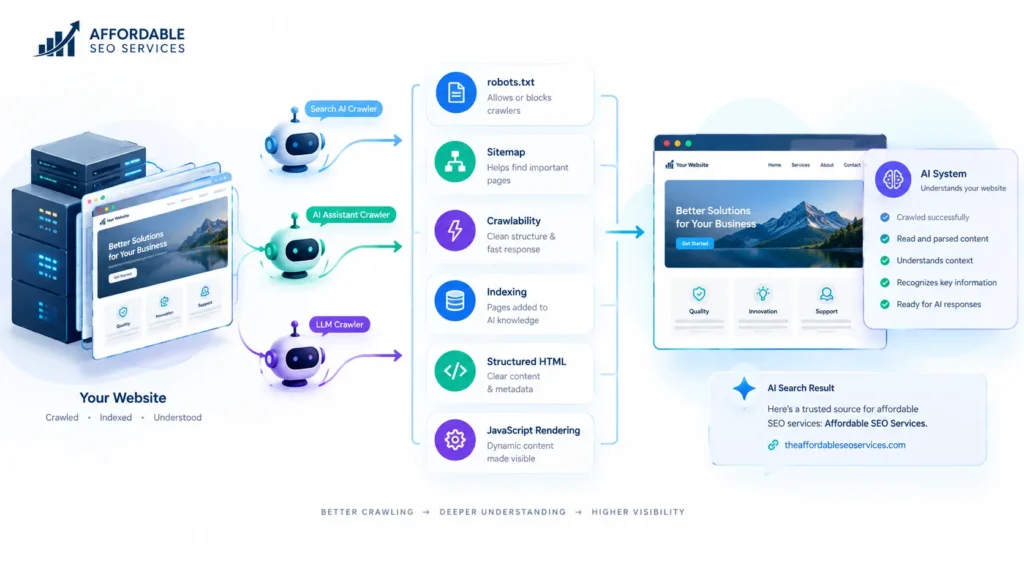
OpenAI operates different crawlers for different purposes. GPTBot is used to crawl content that may be used to improve OpenAI’s foundation models, while OAI-SearchBot is used to crawl websites for inclusion in ChatGPT search results. ChatGPT-User is associated with user-triggered browsing and is different from the automated crawler used for ChatGPT Search. Check your robots.txt file and make sure it is not unintentionally blocking the crawlers you want to access your site. Security plugins, SEO configurations, migrations, or custom robots rules can sometimes introduce restrictions that site owners do not notice.
Worth doing at the same time, since the work overlaps almost completely: add ClaudeBot and PerplexityBot to the same allow list. ChatGPT is not the only assistant sending customers your way, and Perplexity in particular tends to cite sources more visibly than ChatGPT does, so the same technical fix buys you visibility across more than one platform for no extra effort.
This whole area sits under what is often called semantic SEO. Rather than optimizing around isolated keywords, the goal is to make your business a clearly defined entity, meaning a distinct, well-described thing with a name, a category, and a set of attributes that a model can place inside its internal knowledge graph. The more clearly your site states who you are, what you do, and who you serve, the easier that placement becomes.
Add JSON-LD Structured Data
Structured data gives ChatGPT a clean, machine-readable summary of what your page is about instead of forcing it to guess from raw HTML. At a minimum, add Organization schema to your homepage, Article schema to your blog posts, FAQPage schema to any page with a question-and-answer section, and HowTo schema to any page that walks through a numbered process. Here is a simple FAQ example you can adapt.
Create an llms.txt File.
An llms.txt file is a plain Markdown file placed at yoursite.com/llms.txt that summarizes your site for AI systems in one place, similar to how sitemap.xml summarizes it for search engines. It is a newer convention and not every AI system reads it yet, but it costs almost nothing to add and gives crawlers a direct answer instead of a guess.
Fix Pages That Only Render With JavaScript
GPTBot and most AI crawlers do not execute JavaScript. If your site is a single-page application built in React or Vue that renders its content on the client side, the crawler may
see an empty page where a person sees a full one. Server-side rendering or static generation solves this. If you are not sure which category your site falls into, this is the single most common technical issue we find during audits at Affordable SEO Services, and it is often invisible until someone actually checks.
Write Content ChatGPT Wants to Cite
Once the technical side is solid, content quality decides everything else. Start by answering the real question a person has, not the keyword you want to rank for. Someone searching for the best CRM software rarely wants a single ranked list. They want to know which one fits a business their size, what it costs, what breaks at scale, and what to avoid. A page that answers all of that in one place gives a reader no reason to open a second tab, and it gives ChatGPT a complete answer it can summarize confidently.
Publishing one strong article rarely establishes authority on its own. AI systems, much like search engines, look for consistent depth across a topic rather than isolated posts. A cybersecurity blog that covers phishing, endpoint protection, and identity management as one connected set of resources reads as more credible than the same three topics scattered across a site with unrelated posts in between.
Google’s E-E-A-T framework, which stands for experience, expertise, authoritativeness, and trust, was built for search rankings, but the same qualities are exactly what make content citable by an AI model. Show that you have actually done the work rather than repeating what everyone else already wrote. Name real sources for statistics instead of writing vague phrases like research shows. List a real author with real credentials. State clearly when a page was last updated. None of this guarantees a citation, but its absence is one of the fastest ways to get skipped.
Content freshness carries real weight too, especially for anything that changes over time such as pricing, tools, or statistics. A guide from 2023 with no updates since will lose ground to a 2026 article on the same topic that has clearly been revisited. Adding new figures, removing outdated advice, and stamping a visible last updated date signals to both readers and crawlers that the page is actively maintained rather than abandoned.
Format matters almost as much as substance. Open each major section with a direct answer, then expand into detail underneath it. Use tables for comparisons instead of four paragraphs describing the same thing in prose. Add a short FAQ section near the end using the exact phrasing people actually type into a chat window. This structure serves human readers who scan, and it happens to be exactly what a language model needs to extract a clean answer.
Off-Site Signals That Build AI Trust
Your own site is only part of the picture. ChatGPT also weighs how the rest of the internet talks about you. Mentions and links from real, relevant sites in your industry still carry weight, the same way they do for traditional search rankings. A guest post on a site your actual customers read matters more than ten low-quality links from unrelated directories.
For any business tied to a physical location, consistent business information across your website, Google Business Profile, and directory listings removes ambiguity for both people and AI systems. Genuine reviews add another layer ofconfirmation, particularly when a specific service or outcome shows up repeatedly across them.
Original research is worth calling out on its own. A benchmark study, a small survey, or a proprietary framework built from real client work gives other writers and AI systems a specific reason to cite you instead ofone ofa dozen similar articles saying the same general things. One of our clients, a personal injury law firm with a domain rating in the single digits, started appearing in Google AI Overviews for fourteen target keywords within eight weeks after a focused schema and content project, something years of backlink building alone had not produced for them. Authority signals compound, and original, specific work tends to move faster than generic content ever does.
How Do You Know If ChatGPT Is Already Recommending You
No dashboard shows your ChatGPT ranking the way Google Search Console shows your position for a keyword. The most direct method is still manual. Open ChatGPT and ask it the exact questions your customers would ask, phrased the way a real person would type them, and see whether your site or brand comes up. Run the same prompt more than once, since answers can shift between sessions.
A handful of paid tools now handle this kind of AI visibility and prompt tracking at scale, including Otterly.AI, the AI toolkit inside Semrush, Writesonic, and Profound. They run your target prompts on a schedule across ChatGPT, Perplexity, and Gemini, then report how often your brand shows up and where. That kind of tooling earns its cost once you are tracking dozens of prompts a month, but for most small businesses, a manual check across ten or fifteen priority questions once a month is enough to spot whether things are moving.
Mistakes That Quietly Keep You Out ofChatGPT’s Answers
A blocked robots.txt file is the single most common accidental failure, usually left over from a security plugin or a migration nobody double-checked. A close second is a site built entirely in JavaScript with no server-rendered fallback, which looks fine to a person and empty to a crawler. Beyond the technical issues, plenty of sites publish thin, generic content aimed at a keyword rather than a real question, then wonder why nothing gets cited. And a fair number of business owners assume paying for backlinks or ads will buy a mention. It will not. ChatGPT has no paid placement system, and no agency, including Affordable SEO Services, can guarantee a citation. What we can do, and what any credible SEO provider should be doing, is fix the technical and content gaps that make a citation possible in the first place.
Is This the Same as SEO?
Mostly yes, with a few new layers on top. A fast, crawlable, well-structured site was always the foundation of good SEO, and none of that changes here. What is new is the emphasis on structured data, llms.txt files, and content written to be extracted and summarized rather than just ranked. If you want the full comparison, we broke down the differences in more detail in SEO vs AEO: What’s the Difference.
Conclusion
Getting recommended by ChatGPT is not a trick, and there is no setting to flip. It comes down to making sure the crawler can actually reach your content, making sure that content answers the real question better than the next result, and backing it up with genuine signals of trust from elsewhere on the web. Start with the technical check. It takes ten minutes to confirm whether your robots.txt is quietly blocking you, and it is the single most common reason a good site never shows up at all.
If you would rather have someone run that full audit for you, including the AI-specific checks most agencies still skip, Affordable SEO Services offers a free SEO audit that covers exactly this ground before you spend a dollar on ongoing work
Frequently Asked Questions
Can you pay ChatGPT to recommend your website?
No. ChatGPT has no advertising or paid placement system for its answers, so no agency can sell you a guaranteed mention.
Does ChatGPT use Google’s index?
No, ChatGPT uses its own crawlers, including GPTBot and OAI-SearchBot, and does not rely on Google’s search index.
How long does it take to get recommended by ChatGPT?
There is no fixed timeline, but most sites see early movement within two to three months offixing technical access issues and publishing genuinely complete content.
Is optimizing for ChatGPT the same as SEO?
Largely yes. A strong technical SEO foundation is required either way, with structured data and AI-specific formatting added on top.
Does ChatGPT only recommend big, established brands?
No. Smaller sites that answer a specific question clearly and completely are cited regularly, often ahead of larger sites with thinner content on that exact topic.
What is llms.txt and do I actually need one?
It is a plain text file summarizing your site for AI crawlers. It is not required, but it is inexpensive to add and gives crawlers a clear reference point.
Why might robots.txt be blocking ChatGPT without me knowing?
Many default WordPress and security plugin configurations block AI crawlers automatically. Check your robots.txt directly rather than assuming it is open.
Do backlinks still matter for AI search visibility?
Yes. Links and mentions from relevant, trusted sites remain one of the strongest trust signals for both traditional search and AI systems.