
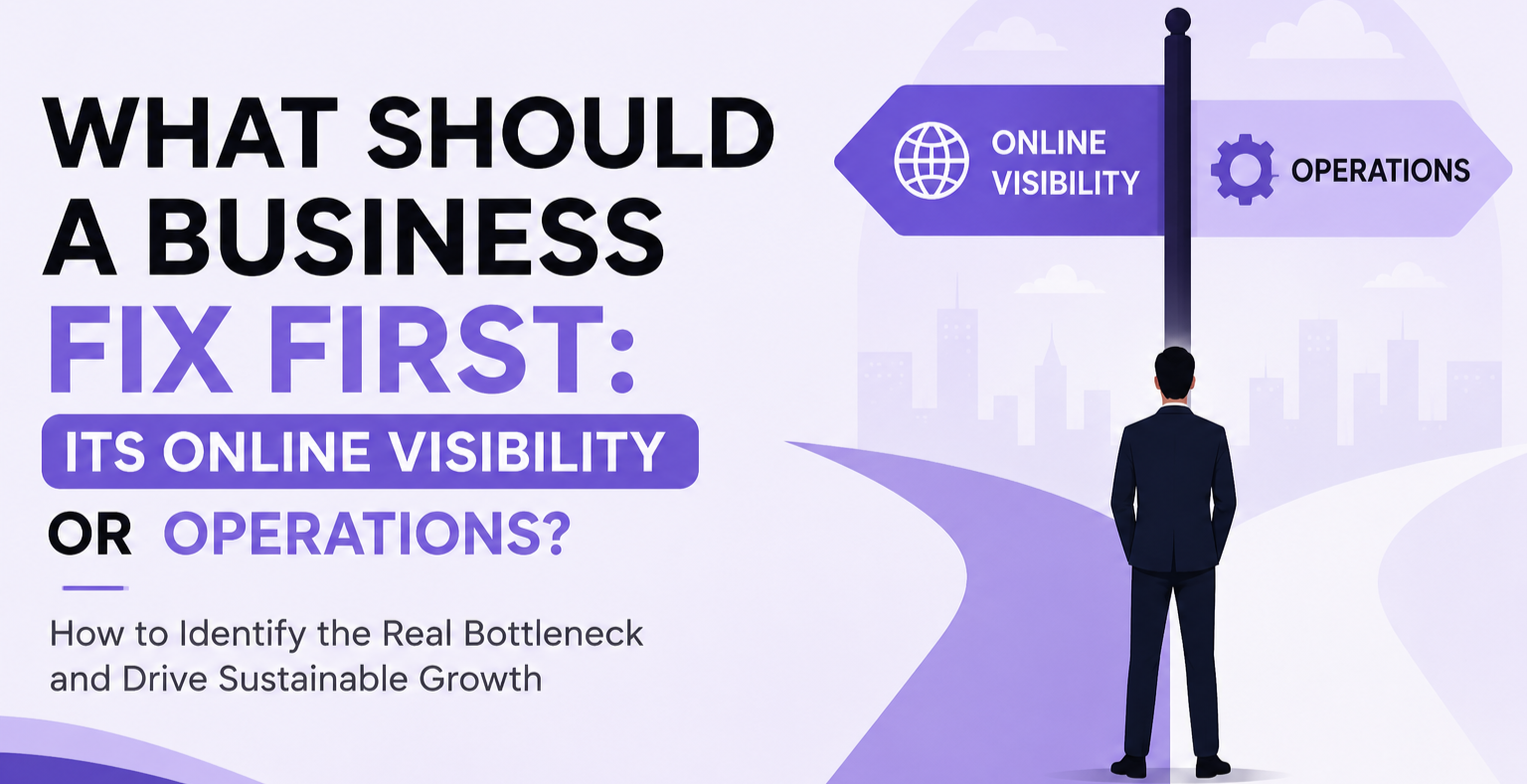
When it becomes difficult for a business to achieve growth, one question that is often asked is whether they should focus on online visibility or internal operations first.
The answer is usually not one or the other. A business needs both, but the right starting point depends on where customers are being lost.
If the problem is that no one can find the business online, just working on operations won’t result in sufficient demand creation. On the other hand, if your website is generating leads, but your team isn’t responding promptly, poor operations may ruin any marketing efforts. A better strategy would be to see which area requires more work, fix it, and then connect marketing with operations.
Is Your Business Visible to the Right Customers?
Online visibility refers to the ease with which potential clients can find your business via search engines, maps, social media platforms, websites, and other digital methods. In most cases, a customer’s experience starts with a search.
The individual searches for a:
- Digital marketing agency based in the USA
- BPO services company based in India
- Customer support firm based in California
- SEO services company for a small business
- Call center for an e-commerce company
Your business needs to feature in these searches, or else there will be other competitors that will get these inquiries.
Local search becomes critical. Research conducted by Google shows that 76% of those searching for a local business on a smartphone visit a business within 24 hours.
This does not mean that every search becomes a sale. It just proves that visibility and customer experience have a direct link.
What should businesses check first?
| Online Visibility Area | What to Check | Why It Matters |
| Website | Speed, mobile experience, content | Helps visitors understand the business |
| SEO | Keywords, technical SEO, pages | Helps search engines understand relevance |
| Local SEO | Business profile, reviews, location details | Helps attract nearby customers |
| Content | Helpful answers and service information | Supports search and AI discovery |
| Reputation | Reviews and brand mentions | Builds trust before contact |
A business that wants to improve its online presence can use professional digital marketing services to bring these areas together instead of treating SEO, content, PPC advertising, and social media as separate activities.
When Operations Should Come First
Now look at a different scenario.
A company has web traffic, calls, emails, and leads. However, there is a delay in responding to the queries. There is a delay in processing orders. Tickets are not being captured. Staff members are spending too much time doing repetitive administrative tasks.
In such a scenario, generating more traffic would actually make the problem worse.
Suppose a company gets 100 qualified inquiries in a month, but answers only 60 of them effectively. Doubling the traffic to 200 would not double its revenues as well. First, it needs a process to handle these inquiries effectively.
Operations are defined as those processes that are involved in making sure the business runs after the customer finds it.
Some examples of operations include:
- Customer service
- Call handling
- Email/chat handling
- Order processing
- Data entry
- Appointments handling
- Technical support
- Back office administration
- Finance and accounting support
For businesses that need additional capacity, inbound call center outsourcing can help handle defined processes while internal teams focus on higher-value work.

The Connection Between Visibility and Operations
The strongest businesses do not treat marketing and operations as two completely separate departments.
They create a connected customer journey.
Search → Website → Inquiry → Response → Service → Follow-up → Retention
A weakness at any stage can reduce the value of the entire system.
For example, strong SEO may bring a visitor to a website. A clear service page may turn that visitor into a lead. But if nobody responds to the inquiry, the marketing investment may not produce the expected result.
This is why businesses should measure both sides.
| Business Stage | Key Question | Useful Metric |
| Discovery | Can customers find us? | Search visibility |
| Website | Can visitors understand our offer? | Engagement and conversion rate |
| Lead | Are inquiries captured correctly? | Lead volume |
| Response | How quickly do we respond? | Response time |
| Service | Are customers receiving consistent help? | Resolution time |
| Retention | Do customers stay with us? | Repeat business |
PwC research also shows why the operational side matters. Its research found that 73% of consumers consider customer experience an important factor in purchasing decisions, while 80% identified speed, convenience, knowledgeable help, and friendly service as important parts of a positive experience.
How Should a Business Decide What to Fix First?
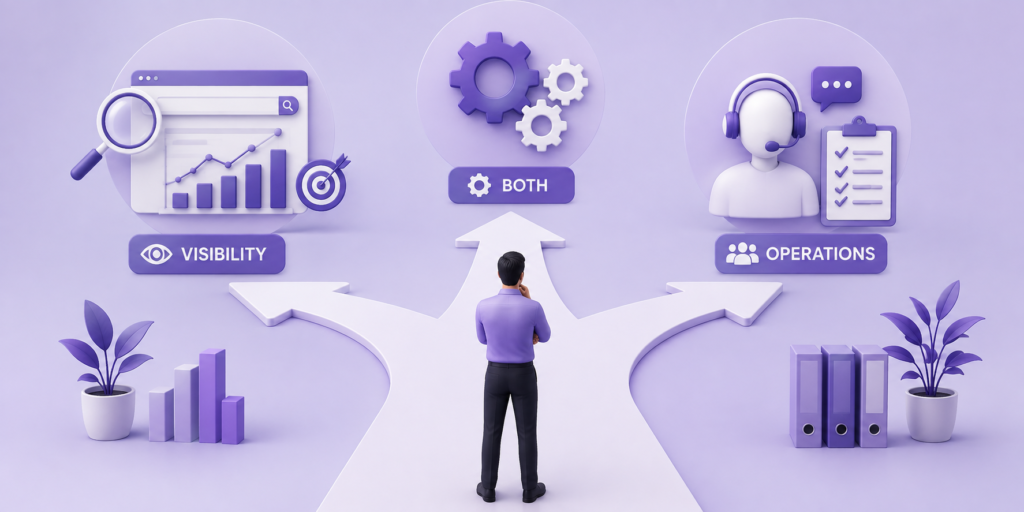
A simple way to decide is to look for the biggest bottleneck.
Start with visibility if:
- Your business receives very little organic traffic.
- Customers struggle to find you through Google.
- Your website has outdated or thin content.
- Important services do not have dedicated pages.
- Your local business information is incomplete.
- Competitors consistently appear ahead of you for relevant searches.
Start with operations if:
- Leads are coming in but are not being followed up.
- Customer response times are too slow.
- Employees spend too much time on repetitive tasks.
- Customer complaints are increasing.
- Orders or support requests are being missed.
- Your team cannot handle additional demand.
Fix both when:
- Marketing generates more leads than your team can handle.
- Customer support service problems are damaging your online reputation.
- Your website promises a level of service that operations cannot deliver.
- Growth has created workload problems across multiple departments.
What About Local and Global Businesses?
The priority can also change based on where a business operates.
A local business in New York, Chicago, Los Angeles, or another U.S. market may need strong local search visibility, accurate business information, reviews, and location-specific content.
A company serving customers across the United States, Canada, the UK, Australia, or India may need broader service pages, strong technical SEO, useful content, and a consistent brand presence across multiple markets.
At the same time, its operations must be able to support customers across the locations and time zones it serves.
This is where GEO becomes increasingly important.
Geographic optimization is not simply adding city names to pages. It means making it clear who you serve, where you operate, what services you provide, and how customers can contact you.
That information can help both traditional search engines and AI-powered discovery systems better understand a business.
A Better Approach: Build a Connected System

Instead of asking, “Should we fix marketing or operations?” businesses should ask:
“Where is the biggest customer journey gap right now?”
- If customers cannot discover you, improve visibility.
- If customers discover you but do not convert, improve the website and offer.
- If customers convert but receive slow support, improve operations.
- If customers receive good service but do not return, improve follow-up and retention.
For companies that need help with customer communication, back-office work, data processing, technical support, or other business processes, Dazonn Assist provides support solutions designed around specific business requirements.
The goal should not be to outsource everything or spend more on marketing simply because competitors are doing it. The better strategy is to identify the process that is limiting growth and invest where it can create the clearest improvement.
Final Answer: Visibility or Operations?
So, where should a business start then?
Address issues in terms of online visibility if customers cannot find the business; address operational issues if the customers can find the business, but it cannot deliver an efficient service.
Often enough, the best solution for a growing company lies in addressing both issues successively.
Create visibility to generate demand; optimize the operations to serve this demand; and, based on this information and customer feedback, optimize the whole cycle.
Once marketing attracts the right customers, and operations provide a reliable experience, growth becomes more than a traffic goal and starts becoming a repeatable business process.
FAQ’s
1. Should a business fix online visibility or operations first?
Fix the area causing the biggest problem. If customers cannot find you, focus on visibility. If you have leads but cannot handle them, fix operations.
2. Why does online visibility matter?
It helps customers find your business through Google, maps, websites, and social media.
3. When should a business focus on operations?
Focus on operations when leads are coming in but response times, customer support, or internal work are slowing the business down.
4. How do visibility and operations work together?
Visibility brings customers in, while good operations help serve them and keep them coming back.
5. How can a business find its biggest problem?
Look at the customer journey from search to purchase and find where customers are being lost.
6. Can SEO affect business operations?
Yes. More traffic and leads from SEO can increase workload, so businesses need the right processes to handle them.
7. How can businesses improve visibility and operations?
Use SEO, content, local search, and PPC to improve visibility, and improve workflows, customer support, and automation to strengthen operations.