
To get cited in Google AI Overviews, publish pages that answer one specific question directly in the first two sentences, keep your structured data accurate, and build consistent entity signals across the web. Google confirms no special schema markup is required. Citations go to clear, factually dense pages from sources Google already trusts.
Your business ranks on page one for a keyword you spent months winning. Then Google writes its own answer above you and names three competitors instead. Learning how to get your business cited in Google AI Overviews is now a separate skill from ranking well, with its own rules. This article covers what earns a citation, what Google says you can skip, and how to check where you stand today. Most of this overlaps with what the industry calls answer engine optimization, so you are rarely starting from zero.
Why being cited now matters more than ranking first
AI Overviews stopped being an experiment a while ago. How often they appear depends on who is counting. Conductor measured them on roughly 25% of 21.9 million searches. Advanced Web Ranking put the figure above 60% of US queries. That gap comes from different keyword samples, not from anyone being wrong.
Either way, the direction is one way. Here is the part most agencies leave out ofthe pitch. When an AI Overview shows up, clicks fall. Seer Interactive studied 3,119 informational queries and found organic click-through rate dropped from 1.76% to 0.61%. Paid dropped from 19.7% to 6.34%. Ahrefs reached a similar conclusion across 300,000 keywords, measuring a 58% drop for top-ranking pages.
That sounds like bad news. It is, partly. But the same Seer study found the reverse for businesses named inside the answer. Brands cited in the AI Overview earned about 35% more organic clicks and 91% more paid clicks than brands left out of the same results page. The pie got smaller. Whether you are cited decides how much of it you get.
What is the difference between SEO, AEO, and GEO?
Three terms describe overlapping work, and the labels confuse more people than they help.
SEO is optimizing to rank in the traditional list of blue links. Answer engine optimization, or AEO, is structuring content so it gets selected as the direct answer to a specific question. Generative engine optimization, or GEO, is the broader practice of earning mentions and citations inside AI-generated answers across ChatGPT, Perplexity, Gemini, Claude, and Google.
Google itself does not treat these as separate disciplines. Its May 2026 guidance on generative AI features makes the position clear. Because AI Overviews and AI Mode run on core Search ranking systems, optimizing for them is still SEO. So treat AI search optimization as an extension of your existing work rather than a replacement for it. The vocabulary is new. The fundamentals underneath are not.
Is getting cited the same thing as ranking number one?
No. The two overlap, but they run on different rules. A Surfer SEO study from December 2025 found that 68% of pages cited in AI Overviews were not in the top 10 organic results for the original query. They ranked for related searches instead.
The reason is query fan out. When someone asks a question, Google breaks it into several smaller searches behind the scenes, runs each one, and builds an answer from the whole pool. Your page does not have to win the main keyword. It has to win one of the sub-questions.
This changes what you build. A single page stuffed with one keyword competes for one slot. A set of pages covering every service you offer and every question customers ask competes for a dozen. That breadth is what people mean by topical authority, and it feeds AI answers far better than one long article ever will.
Learning how to rank in AI Overviews therefore starts with coverage, not with word count.
Do AI Overviews hurt or help your traffic?
Both, and the split depends entirely on whether you are named. Pew Research Center analyzed 68,879 Google searches and found that just 1% of users clicked a source link inside an AI-generated summary. Traditional click-through rate on those same searches fell to 8%, roughly half the rate on searches without a summary. This is what the industry means by zero-click search. The answer gets consumed on the results page.
Impressions tell a different story. BrightEdge measured impressions rising around 49% for the same pages in the year after AI Overviews launched. People are seeing your brand more and clicking it less. Treat citation as a branding and trust channel first, and a traffic channel second. That reframing matters when you set expectations with anyone paying for the work.
How is an AI Overview different from a featured snippet?
A featured snippet pulls a passage from one page. An AI Overview synthesizes an answer from several sources and lists multiple citations underneath.
The practical difference is opportunity. Only one site wins a featured snippet. An AI Overview can name four or five, which means a smaller business can appear alongside a national brand rather than losing to it outright. Both reward the same thing. A short, clean, self-contained answer sitting close to a heading.
Does Google require special schema markup for AI Overviews?
No. Google’s own Search Central documentation on AI features states there are no additional requirements and no special structured data needed to appear in AI Overviews or AI Mode.
That is worth sitting with, because a great deal of advice sells the opposite. Adding FAQPage markup is not a shortcut into the answer box.
What structured data does do is remove ambiguity. Schema markup, written in JSON-LD and defined by the Schema.org vocabulary, tells a machine what your business is, where it operates, and what each page covers, in a format it cannot misread. Google’s guidance adds one condition. If you use structured data, it must match the visible text on the page.
The types that earn their place for a small or local business are Organization schema, LocalBusiness, Service schema, FAQPage, and BreadcrumbList. Mark up your business details, your individual services, and the questions you genuinely answer on the page.
One detail matters more than most people realize. Listing each service by name inside your Service schema gives a model something specific to quote. A drywall company that declares “popcorn ceiling removal” as a named service is far easier to cite than one that writes “full range of drywall solutions” in a paragraph.
Validate everything in Google’s Rich Results Test before and after you publish. Then treat markup as hygiene rather than as the strategy. If the page has nothing worth citing, no amount of code underneath fixes that.
Fix the technical foundation before anything else.
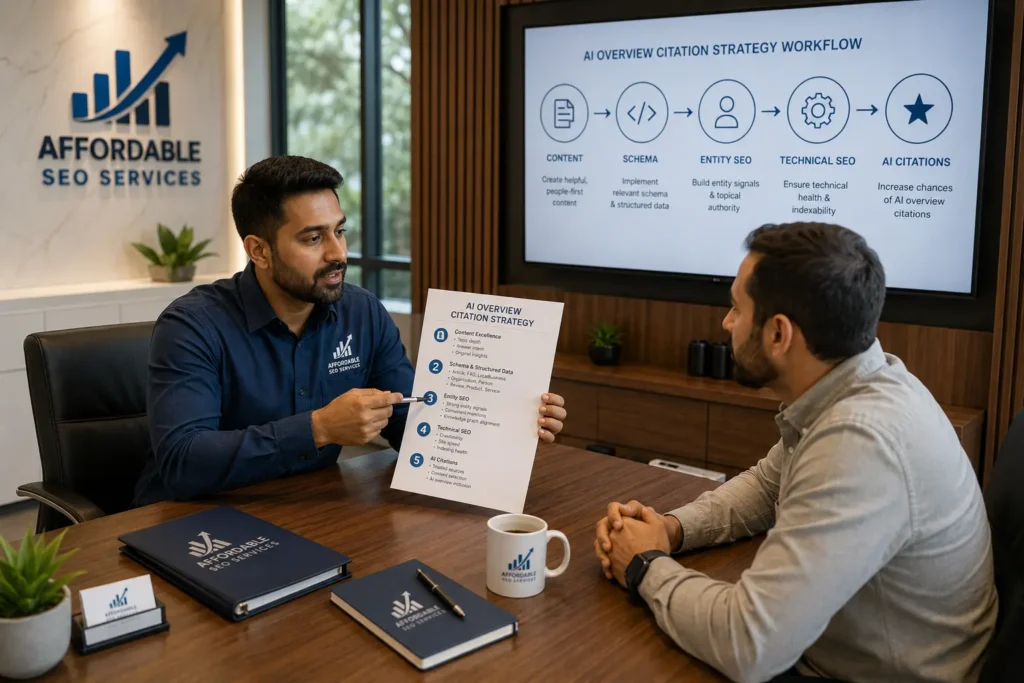
Google will not cite a page it cannot crawl, render, and index. This is where a surprising number of businesses lose before they start.
1. Confirm every important page returns a 200 status and carries no noindex directive.
2. Check that your main content is server-rendered and appears in the raw HTML, not only after JavaScript runs. Heavy page builders and plugin stacks often bury text this way.
3. Test page speed and Core Web Vitals on mobile, since that is where most searches happen.
4. Submit an up-to-date XML sitemap in Google Search Console and clear any coverage errors.
5. Fix redirect chains and broken internal links, which waste crawl budget on nothing.
Point two catches the most businesses. If your text and your schema only load after a pile of scripts finishes running, some crawlers see a much thinner page than your visitors do.
Google can often render JavaScript eventually. The crawlers behind ChatGPT and Perplexity are less patient.
None of this is glamorous. It is also why our technical SEO work usually comes before content work on a new account. A brilliant answer nobody can read is not an answer.
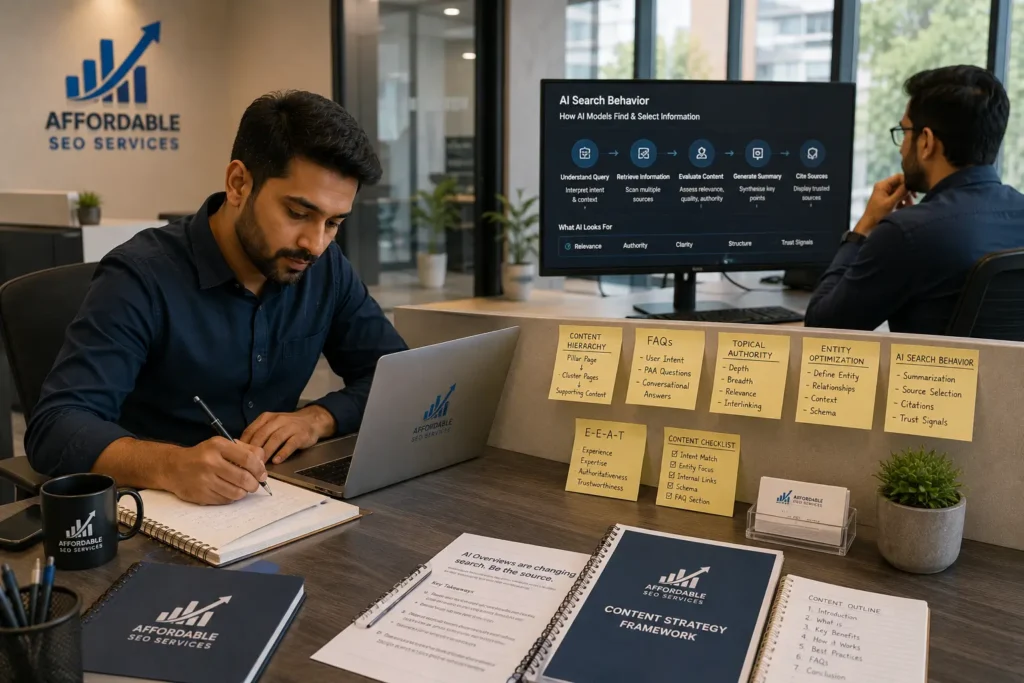
How do you structure content so an AI can lift it?
Write it so a machine can pull one clean chunk without dragging in noise. That is the whole idea behind extractable content.
Answer the question in the first two sentences.
Put the answer at the top, then explain underneath. If a reader has to scroll past three paragraphs of setup to find your point, so does the model, and it usually grabs a competitor instead. Aim for 40 to 60 words that stand alone as a complete answer.
This answer-first structure is the single easiest change most sites can make this week.
Replace vague claims with real numbers.
“Fast, affordable service” is unquotable. “Most repairs run $150 to $400 with same-day response” is something a model can hand to a user.
The GEO research presented at KDD 2024 by teams from Princeton, Georgia Tech, the Allen Institute, and IIT Delhi tested this directly. Adding statistics, citations, and authoritative quotations lifted a source’s visibility in AI answers by up to 40%.
Cover the whole topic, not one angle.
Surfer analyzed 57,253 URLs across 1,591 keywords and compared cited pages with ignored ones. Pages cited in everyAI Overview for a keyword covered roughly twice the factual ground of pages never cited at all.
Depth wins. Not word count, but the number of real questions a page settles.
Write in self-contained sections.
One idea per section. The heading is the question, the paragraph under it is the answer.
Short, complete blocks give a model something clean to quote.
Add a genuine FAQ
Not a keyword dump. Five to eight questions customers actually ask, each answered fully in one or two sentences before any expansion.
Build the entity signals that make your business easy to trust
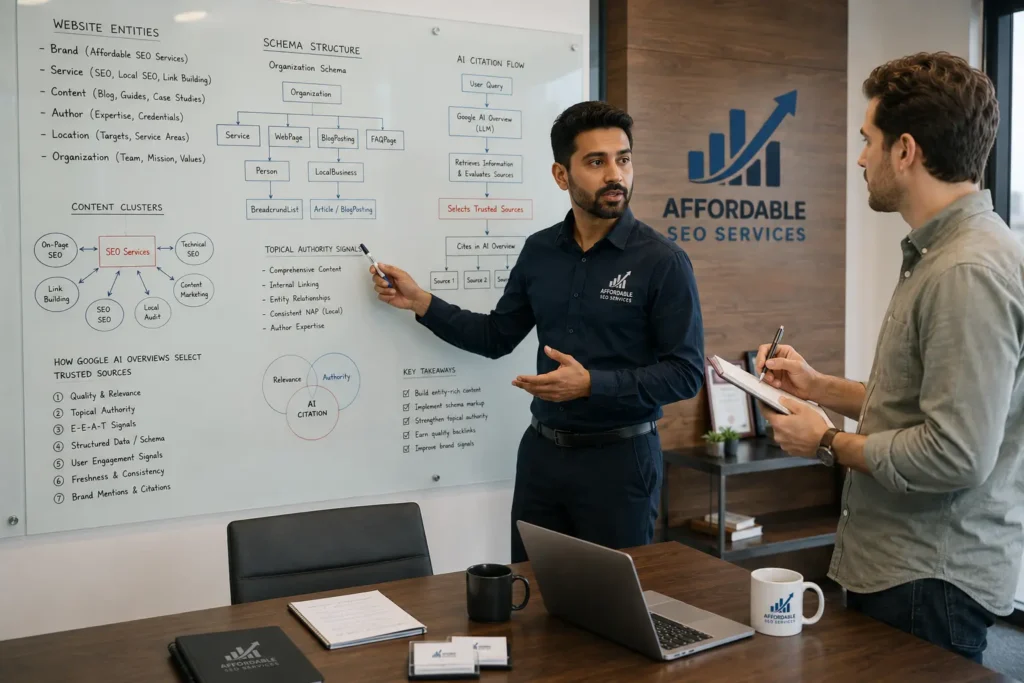
Models cross-check your business against the rest of the web before naming you in an answer. If they cannot tell who you are, they skip you. This is entity clarity, and it is what puts a business into Google’s knowledge graph as a recognized thing rather than a URL.
Start with consistency. Your business name, address, and phone number should be identical everywhere they appear, on your site and off it. Mismatched details are one of the fastest ways to make a system distrust you, which is why NAP consistency matters more now than it did five years ago.
Then fill in the rest of the picture. A complete Google Business Profile. An About page naming real people with real credentials. Author bylines on your articles instead of anonymous posts. Accurate listings on the directories that matter for your industry, not a hundred junk ones.
All of this maps onto E-E-A-T, the experience, expertise, authoritativeness, and trustworthiness framework Google uses to judge quality. Reviews and third-party mentions count here too. A model deciding whether to vouch for you is looking for corroboration, and one press mention in a local publication does more than fifty spam citations.
Domain authority still applies, though less absolutely than it used to. For competitive national terms, editorial link-building should run alongside content work. For narrow local questions, a modest domain can win outright.
Do AI Overviews, AI Mode, and ChatGPT cite the same sources?
Not really, and this trips up businesses optimizing for one surface only.
A Semrush comparison study found Google’s AI Mode overlaps with the top 10 organic results only about 35% of the time. Classic AI Overviews overlap around 67%. Perplexity sits above 82%. AI Mode also pulls from a wider spread of domains and routinely cites pages ranking past position 21.
Scale explains why this matters. At Google I/O 2026, Google reported AI Mode had passed one billion monthly active users, with AI Overviews reaching over 2.5 billion.
Here is the short version of how the major engines behave:
- Google AI Overviews lean hardest on pages already ranking in organic search.
- Google AI Mode casts a wider net and pulls deeper results, so classic rankings help less.
- ChatGPT draws on a different index and third-party sources, which is why getting mentioned by ChatGPT often depends more on being written about elsewhere than on your own rankings.
- Perplexity favors recency and source variety, so freshness carries extra weight.
- Claude and Bing Copilot overlap meaningfully with Google rankings, so gains there usually follow the same foundation work.
The foundation overlaps everywhere. Only the weighting changes, so build once and fine tune per engine.
What are Google Preferred Sources and why do they matter?
Preferred Sources is a Google feature that lets a user pin favorite sites for prioritized visibility across regular search, AI Overviews, and AI Mode. Google states people are roughly twice as likely to click through to a source they have marked as preferred.
Almost nobody is asking for this yet, which is exactly why it is worth doing. A small, visible prompt inviting repeat visitors to add your site takes an afternoon to implement.
The signal it builds compounds. Direct preference from real humans is difficult for a competitor to copy and impossible to buy.
Where should your business type start?
Google AI Overview optimization is not one playbook. The order of operations changes with the business.
Local service businesses.
Start with local SEO. A complete Google Business Profile, consistent NAP data, real reviews, and a dedicated page for every service in every area you cover. Local business AI citation follows local visibility almost directly, and our local SEO
services exist for this reason. Pew found 60% of question-style queries triggered an overview, against just 8% of one- or two-word searches, so target the long questions people actually ask.
Ecommerce stores
Expect less. Shopping and transactional queries sit at the bottom of the AI Overview prevalence range, around 13% to 14%. Put your effort into buying guides, comparison pages, and product FAQs rather than category pages, since those are the queries that trigger an answer.
B2B and SaaS
Comparison and definition queries are your ground. Build pages that answer “what is X”, “X vs Y”, and “how much does X cost” with real numbers, then support them with third-party coverage so models see corroboration outside your own domain.
AI Overview SEO for small business works best when you pick the one segment above that fits and ignore the other two for a quarter.
What this looks like for a real small business
Abstract advice is easy. Here is a concrete case. A personal injury law firm in Dallas that we work with at Affordable SEO Services started at a domain rating of 9, against a main competitor sitting at 55. After schema and content restructuring, they reported appearing in Google AI Overviews for 14 of their target keywords within eight weeks. Their own summary was that AI visibility did what backlinks could not have done in a year.
One caveat, stated plainly. That is a single client in one market, and legal queries trigger AI Overviews far more often than retail queries do. Treat it as evidence that low authority sites can get cited, not as a timeline you should expect.
How do you check whether you are already being cited?
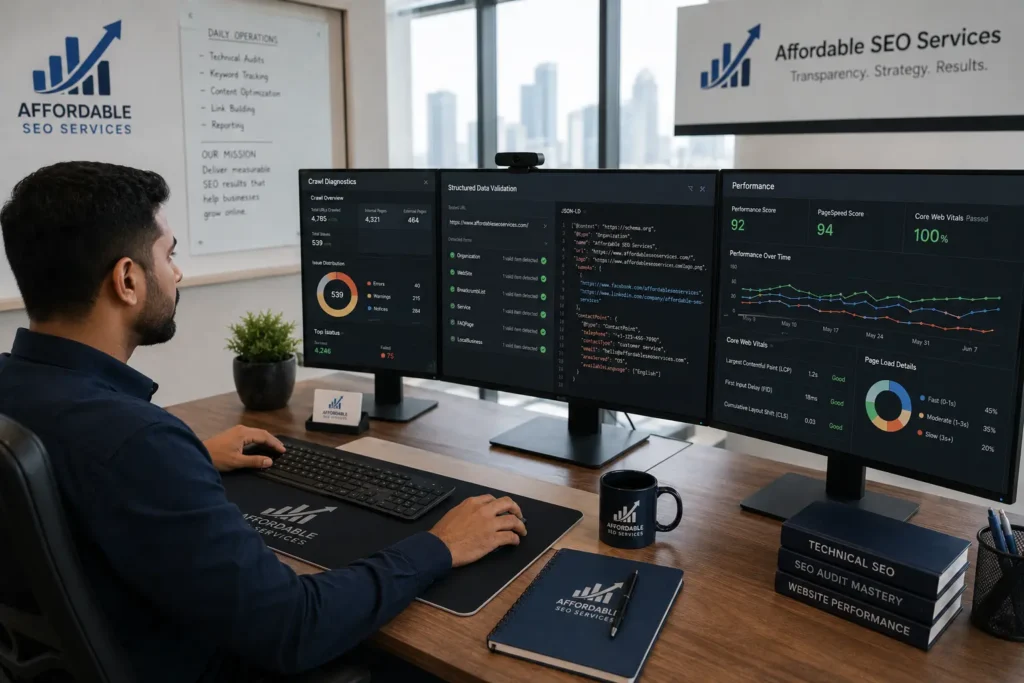
Run the test yourself before changing anything. It takes about twenty minutes and tells you more than most paid audits.
1. Open ChatGPT, Perplexity, and Google in an incognito window so results are not shaped by your history.
2. Run the questions your customers would actually type, such as “best plumber in Phoenix” or “how do I choose an accountant.”
3. Record which businesses get named and which websites the answer cites, one row per query in a simple sheet.
4. Check GA4 for referral traffic from chatgpt.com, perplexity.ai, and gemini.google.com. Volume is small, but intent is high.
5. Repeat the same prompts monthly and watch whether your name starts appearing.
For ongoing tracking, Semrush’s AI Visibility tools and Ahrefs Brand Radar both report mentions and cited pages by domain. Those tools describe the result as citation share of voice, or share of model, meaning how often you appear versus competitors for the same set of prompts. Google Search Console will show impressions, though it does not separate AI Overview appearances cleanly.
Be skeptical of precision. If someone hands you an AI ranking report with exact positions, ask where the numbers come from. Most of it is estimated. The honest measure right now is directional. Are you named more often than you were three months ago, yes or no?
How often should you refresh a page that already gets cited?
There is no published figure worth staking a claim on, and anyone quoting one precisely is guessing. What the team at Affordable SEO Services sees in practice is that pages covering prices, tools, platform features, or regulations lose ground faster than evergreen explainers.
Content decay is real on those topics. Reviewing them every six to nine months and showing a visible last updated date is a reasonable default.
Freshness matters unevenly across engines. Perplexity weights it heavily. Google weights it by topic. Evergreen explainers can go much longer between updates without losing citations.
Where to start this week
If you take one thing from this, make it the distinction between ranking and being named. They are related but separate goals, and the second is won by pages that answer a narrow question completely, in plain language, near the top, backed by details nobody else has published.
Pick your single most important page. Read the first paragraph. If it does not directly answer the question that page targets, fix that before touching anything else.
Want to know exactly where you stand?
Our AI SEO services at Affordable SEO Services include running your real customer questions through Google AI Overviews, ChatGPT, and Perplexity so you can see who is being cited for you instead. It starts with a free SEO audit, no contract and no pitch, and it is the fastest way to find out how to get your business cited in Google AI Overviews for the searches that pay your bills.
Frequently asked questions
Can you guarantee my business will get cited in AI Overviews?
No, and any agency that guarantees it is selling you something. There is no admin panel or ad slot for AI answers.
How long does it take to get cited?
For most businesses, three to six months of consistent work. Sites that already rank well tend to get picked up sooner.
Is this different from regular SEO?
It builds on top of it. Google’s own guidance treats optimizing for AI features as ordinary SEO rather than a separate discipline.
Do I need to optimize for ChatGPT and Perplexity separately?
The core work overlaps, so start with one foundation. Fine-tune per engine only once you are tracking each one separately.
Does adding FAQPage schema guarantee a citation?
No. Google states no special structured data is required, and markup that does not match your visible page content can hurt more than help.
Can a low authority site get cited at all?
Yes, particularly for specific long tail questions where big brands have not bothered to publish a clear answer.
How do I appear in Google AI Overviews for local searches?
Fix your Google Business Profile, keep NAP data consistent, and publish a separate page for each service and service area you cover.
What is the difference between an AI Overview and AI Mode?
AI Overviews sit above normal results on a standard search. AI Mode is a separate conversational surface that pulls from a wider pool of pages.