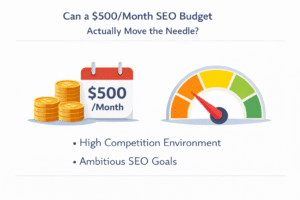


Figuring out how to budget for SEO can feel like throwing darts in the dark. One agency quotes five hundred dollars. Another wants five thousand. Nobody explains why. This guide breaks down how to budget for SEO as a business. It works whether you run local SEO on a budget for a single storefront. It also works if you just need a leaner way to compete with bigger players doing SEO on a budget. At Affordable SEO Services, small business owners ask us this exact question every week. This SEO budget plan comes from real client numbers, not guesswork.
Budget for SEO by setting your total marketing spend at 7 to 8 percent of gross revenue. That is the range the Small Business Administration recommends for companies under 5 million dollars. Then route 25 to 50 percent of that marketing budget into SEO itself.
That one formula solves most of the arguments about SEO pricing. The harder part is deciding where that SEO money actually goes, and that is what this guide covers next.
What Is an SEO Budget and Why Guessing Costs You Money
An SEO budget is the amount you set aside, month after month, for search engine optimization work. That includes content marketing, technical fixes, link building, keyword research, and the tools you use to track all four.
Most owners never write an SEO budget plan down. They approve a content writer here, a one-time audit there, and a link package somewhere else, and none of it connects to a plan. Six months later, they cannot say what worked, because nothing was ever measured against a target.
A written budget fixes that. It forces you to pick a percentage of your marketing spend for organic search. It also gives you a number to hold your agency, freelancer, or in-house team to.
How Much Should You Budget for SEO?

What percentage of revenue should go to marketing overall?
The Small Business Administration says businesses under 5 million dollars in revenue should set aside 7 to 8 percent of gross revenue for marketing. That covers a full digital marketing budget, not SEO alone. The number assumes net margins in the 10 to 12 percent range, and it is one of the few government-backed benchmarks a small business owner can point to. Most owners who research this land on a small business marketing budget percentage somewhere between 7 and 9 percent of revenue.
Two private surveys land close to that same range. Gartner’s 2025 CMO Spend Survey puts average marketing spend at 7.7 percent of revenue. The Deloitte and Duke CMO Survey
runs a bit higher, closer to 9.4 percent. Newer, faster-growing companies tend to sit near the top of that range. Established businesses with steady referrals often sit closer to the bottom.
Forrester Research has reported that companies devote roughly half of their overall marketing budget to digital channels such as SEO, email, and social media. That is worth remembering before you shrink the SEO line to make room for something else. A proper seo audit, run before you set any number, tells you exactly which of these channels your business actually needs most.
What percentage of that should go to SEO specifically?
Once you know your total digital marketing budget, the next question is how much should I spend on SEO specifically. Search Engine Journal and tool makers like Surfer SEO point to a similar answer. Businesses that treat SEO as a main growth channel, not a side project, tend to route 25 to 50 percent of their marketing budget into it. Your SEO budget percentage of revenue matters more than the raw dollar figure, since it scales with you as your business grows.
A simple SEO cost calculator you can use today
Here is a small SEO cost calculator you can run by hand. Take a business earning 2 million dollars a year. Use the SBA’s 7.5 percent midpoint, and that gives a 150,000-dollar yearly marketing budget. Put 35 percent of that toward SEO, and you land on roughly 52,500 dollars a year, or about 4,375 dollars a month. That is a realistic seo budget for small business owners in a growth phase, not a number pulled from thin air.
Typical SEO spending ranges by business size.
| Business stage | Typical monthly SEO spend | What it usually buys |
| Local or single-location business | 500 to 2,500 dollars | Local SEO, Google Business Profile work, a handful of pages a month |
| Growing regional | 2,500 to 7,500 dollars | Content production, on-page fixes, steady link |
| business | building | |
| National or enterprise | 7,500 to 20,000 | Full content teams, digital PR, ongoing |
| SEO program | dollars or more | technical work |
Nutshell, a CRM company that publishes its own SEO pricing research, reports a similar split. Local campaigns typically run 500 to 2,500 dollars a month. National campaigns often run 2,500 to 10,000 dollars a month or more, depending on competition. That answers how much does SEO cost per month for most small and mid-size businesses in the United States.
Local SEO on a budget for a single-location business

Say you run one location, a restaurant, a clinic, a repair shop. Most of your SEO budget should go toward cheap things to do and hard for a bigger competitor to outspend. Claiming and filling out your Google Business Profile costs nothing but time. Collecting real customer reviews helps too. So does keeping your address and hours the same across every directory. Publish a handful of pages built around your actual service area, and that beats a flashy content calendar for a business this size.
A single-location business can often run local SEO on a budget as low as 500 to 1,000 dollars a month. Spend it mostly on a few pieces of content and basic technical upkeep. That budget can still outrank a competitor spending three times as much on generic, poorly targeted content.
How to Split Your SEO Budget Across Content, Links, and Technical Work
Once your total SEO number is set, split it across three buckets. Skip one of them, and the other two stop working as well as they should. This split is the core of any real SEO budget allocation.
Content and on-page work usually takes the largest share, often 40 to 50 percent of the total. This covers blog posts, service pages, and product pages. It also covers the keyword research and on-page fixes that go into each one, things like title tags, internal linking, and matching a page to a real search intent.
Off-page work, mainly link building and digital PR, typically takes 30 to 40 percent. FatJoe, an agency that publishes its own SEO budgeting research, backs this up. So does data compiled by eLearning Industry. Links remain one of the clearest ranking factors Google uses. A strong backlink profile rarely disappears from the budget entirely, even on a lean plan.
Technical SEO usually takes the smallest slice, around 20 to 30 percent. This covers site speed, mobile usability, Core Web Vitals, crawl budget, and basic crawlability. Skip this bucket, and even great content can sit unindexed or slow to load. That quietly caps how well the other two buckets perform.
How to Budget for SEO Step by Step
- Run an audit first. Use Google Search Console and a crawler like Screaming Frog to find what is already working, what is broken, and where competitors outrank you.
- Set one specific goal. Decide whether you want more organic traffic, more local leads, or higher rankings for a set list of keywords, and write that goal down before spending anything.
- Check what competitors are actually spending. Tools like Semrush or Ahrefs can estimate a competitor’s traffic value and content output, which shows roughly what level of spend you are up against.
- Choose your allocation split. Apply the content, links, and technical percentages above, then adjust based on your audit results.
- Decide who does the work. Compare an in-house hire, a freelancer, or an agency against your budget and how much oversight you can give.
- Set a review cadence. Check Google Search Console, Google Analytics, and your rankings every month. Revisit the full budget every quarter and shift money toward whatever is actually working.
DIY SEO Freelancer or Agency Which Fits Your Budget

An in-house SEO hire gives you the most control and the deepest knowledge of your business. But one person rarely covers content, technical work, and link building equally well. A full-time salary usually only makes sense once your monthly SEO budget clears five figures.
A freelancer or small team costs less month to month. They can focus on exactly the gap your audit found, whether that is technical fixes or content production. You just take on more of the coordination work yourself.
Doing SEO yourself, often called DIY SEO, can work for a very small business willing to learn keyword research and basic on-page fixes. It takes real time, so weigh that time against what an outsourced SEO provider would charge for the same work.
An agency spreads a full set of specialists- content, technical, and outreach- across one shared retainer. This usually works best for a business spending a few thousand dollars a month, not tens of thousands. Seo agency cost USA figures run from a few hundred dollars a month for basic local work to five figures a month for competitive national work. Fair seo pricing for US small businesses always breaks down into the same three buckets used above, so ask any provider to show you that split.
Whichever route you choose, insist on visibility into the same core numbers.
- Rankings and keyword data from a tool like Semrush or Ahrefs
- Crawl and index data from Google Search Console
- Traffic and conversions from Google Analytics, also called GA4.
- A monthly report you can actually read, whether that comes from Databox, a shared spreadsheet, or a plain email
Tools You Will Pay For and What They Cost
Most SEO budgets include a small tools line, even if it never gets its own paragraph in a proposal. Keyword research and rank tracking tools such as Semrush, Ahrefs, Ubersuggest, and Serpstat usually cost 100 to 500 dollars a month, depending on the plan. Google Search Console and Google Analytics are free and should be the first two accounts any provider sets up for you. This seo tools cost is small compared to labor, but it adds up across a full stack. Databox and similar dashboards turn all that raw data into simple SEO KPIs. You can check them each month without logging into five different tools. If you want outside context on seo agency pricing or a general seo retainer, aggregators like Statista compile many of these benchmarks in one place, which is useful for a second opinion before you commit to a number.
SEO Budget by Industry and US Region
An SEO budget for a small business rarely looks the same across every industry. Ecommerce SEO usually needs more money for product page content and technical work. Large catalogs create real crawl budget problems, and those take time to fix. Legal and home services businesses, think HVAC and plumbing, tend to lean harder on local SEO and reviews. SaaS companies often spend more on content marketing aimed at long, specific search terms tied to their product.
Location matters too. Local SEO on a budget costs more in a competitive metro area. Think New York, Los Angeles, San Francisco, or Chicago. More competitors bid for the same rankings and the same specialists there, so prices climb. Anyone comparing seo cost USA figures online will see this same pattern: higher prices in big competitive cities and lower prices almost everywhere else.
Should You Split Budget Between SEO and PPC?
Yes, most businesses benefit from running both. The right SEO vs PPC budget split depends on how fast you need results. SEO takes longer to build momentum, often three to six months before real movement. But the traffic it earns keeps arriving without an ongoing cost per click. PPC delivers traffic right away, then stops the moment you stop paying.
A common approach keeps PPC running for immediate demand while SEO compounds in the background. As rankings mature and cost per lead drops, budget shifts gradually toward SEO. Businesses with a longer runway tend to see the biggest return from leaning into SEO early. Content and links published today keep working years later.
What Does an SEO Budget Look Like as AI Search Grows?

Search results increasingly include AI-generated summaries. Tools like ChatGPT and Perplexity now answer questions that used to send someone straight to Google. This does not replace an SEO budget, but it does change what part of that budget should fund.
Set aside a small slice of your content budget for clear, structured answers and pages that directly answer common questions. That work helps your content get pulled into AI-generated answers as well as traditional rankings. There is not yet one reliable industry figure for how much budget this needs. The safest approach treats it as part of good content work, not a separate line item with its own fixed percentage.
Is SEO Spend Tax Deductible?
Generally, yes. The IRS treats ordinary and necessary marketing costs as deductible business expenses. SEO work fits squarely into that category. That said, this is general information, not tax advice. The specifics can vary based on your business structure and how the expense gets categorized. Confirm the details with a CPA before you file.
Signs Your SEO Budget Is Too High or Too Low
A budget that is too low usually shows up as inconsistent publishing or a technical audit that never gets fixed. Sometimes it shows up as a link-building line item that quietly
disappears the moment cash gets tight. If your organic traffic has been flat for six months despite steady spending, the budget is probably too thin to move anything.
A budget that is too high looks different. You are paying for content nobody reads, tools nobody logs into, or a retainer that covers work an audit already flagged as unnecessary. If you cannot tie your monthly SEO spend to a real outcome in Google Search Console or Google Analytics, the number probably needs to shrink before it needs to grow.
How Do You Calculate SEO ROI?
The formula is simple. Subtract your total SEO cost from the revenue that organic search generated. Then divide that number by your total SEO cost.
Say a business spends 1,500 dollars a month on SEO. That work drives 200 extra visitors, and five of them become customers worth 800 dollars each. That is 4,000 dollars in new revenue against 1,500 dollars spent, for a return of roughly 1.7 times the investment in that single month. And that does not even count what happens next, since most of those pages keep ranking and converting well past month one. This kind of return on investment tends to improve over the full SEO results timeline, not just the first month.
The One Number That Actually Matters
The percentage split, not the total dollar amount, decides whether an SEO budget works. A 1,000-dollar budget split correctly across content, links, and technical work beats a 3,000-dollar budget dumped entirely into content. Money spread across all three buckets simply works harder.
If you want a second opinion on your current split, or a free SEO budget template to start from, Affordable SEO Services reviews budgets like this for small businesses every day. One conversation is usually enough to tell you whether your money is going to the right places.
Frequently Asked Questions
Is SEO worth the investment for a small business?
Yes, for most businesses. SEO keeps producing traffic long after the initial spend, unlike ads that stop the moment you stop paying.
How much should I spend on SEO?
Most small businesses spend 7 to 8 percent of gross revenue on total marketing, then put 25 to 50 percent of that toward SEO.
How much does SEO cost per month?
Local budgets often run 500 to 2,500 dollars a month. National or enterprise SEO budgets often run 2,500 to 20,000 dollars a month or more.
What percentage of revenue should a small business spend on SEO?
Most small businesses spend 7 to 8 percent of gross revenue on total marketing, per the Small Business Administration, then route 25 to 50 percent of that into SEO.
What is included in an SEO budget?
A full SEO budget usually covers content creation, on-page fixes, link building, technical work, tools, and either staff time or an agency retainer.
Is it better to hire an agency or handle SEO in-house?
It depends on your budget and time. An in-house hire gives more control but costs more upfront, while an agency spreads specialized skills across a smaller monthly retainer.
How long does it take to see results from an SEO budget?
Most businesses see early movement within three to six months, with stronger results appearing between six and twelve months of steady spend.
Is SEO cheaper than PPC over time?
Often, yes. PPC traffic stops the moment you stop paying, while SEO content and links keep generating visits long after the initial spend.
What happens if I hire a cheap SEO provider?
Cheap seo providers often rely on low-quality links or thin content, which can trigger penalties. Undoing that damage usually costs more than a fairly priced provider would have charged from the start.
Is SEO spend tax-deductible?
Generally, yes, as an ordinary business expense, though you should confirm the specifics with a CPA for your situation.